


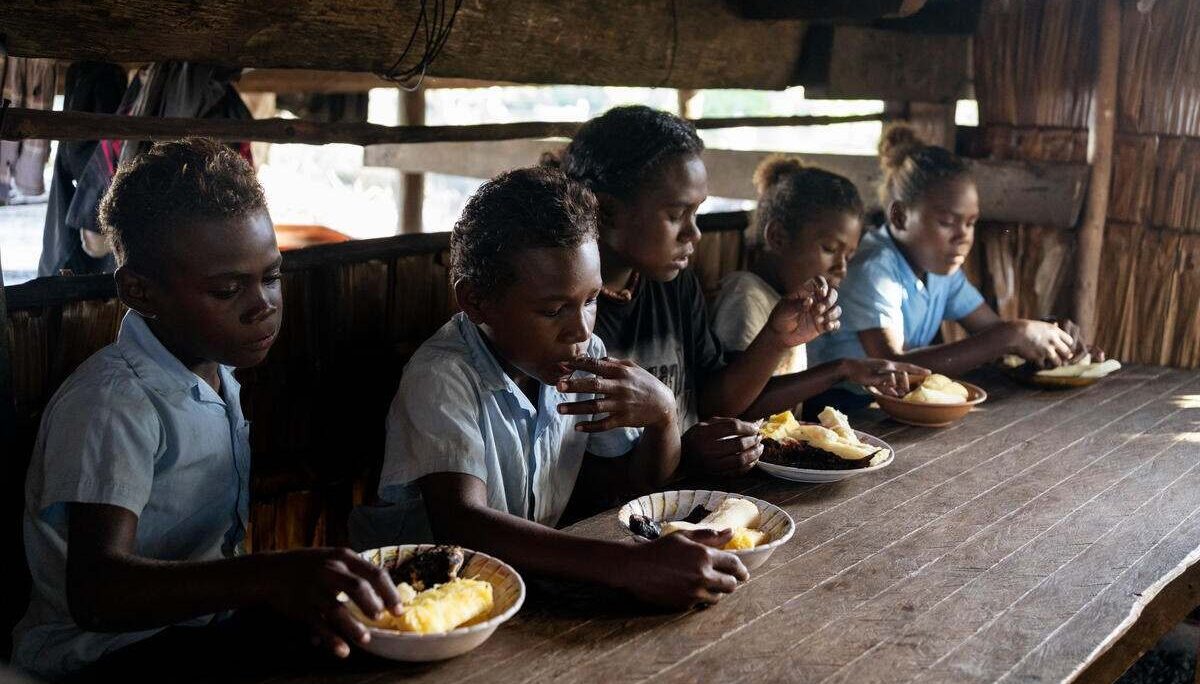
When Pacific leaders consider invoking the Biketawa Declaration, the region’s highest collective crisis framework, last used for the COVID-19 pandemic response, it is a clear sign that the fuel crisis is no ordinary disruption. For the Pacific’s children and families, it is already turning up in day-to-day decisions like how to stretch meals, whether a child can attend school and which essentials get left for next week.
As fuel prices rise globally, Pacific Island countries are particularly exposed. With most food, fuel, medicines and basic supplies imported, higher fuel costs are driving up living costs and tightening household budgets.
In Port Moresby, a student whose daily bus fare almost doubled overnight from K6 (US$1.41) to K10 (US$2.35) had to decide between school or food. He could afford the fare or lunch. Not both. This kind of trade-off directly affects whether children get to school, eat adequately or access basic services.
In Vanuatu, similar decisions are being made inside households. A Save the Children staff member in Port Vila said her household budget no longer stretches the way it once did, leading to them now portioning meals and deciding to grow some of their own produce.
These pressures are also making it harder for humanitarian services to reach families. Responders working after Tropical Cyclone Maila in Solomon Islands and Papua New Guinea say transport costs are climbing as fuel prices rise and community petrol stores have been washed away. For families already hit by disaster, that means help can be delayed and more expensive to deliver.
These two realities sit side by side: ongoing disaster response and a cost-of-living crisis that is pushing up the price of transport, goods and repairs. This is not a fuel shortage yet, but the price shock is already forcing families on the edge to cut back, with tougher months likely ahead.
The crisis is unfolding unevenly and with growing severity. The Marshall Islands declared a 90-day state of economic emergency while Tuvalu declared a state of emergency amid daily blackouts. In Fiji, fuel prices rose suddenly with unleaded up 20%, diesel up 35%, kerosene up 42% and the government announced plans for transportation subsidies, fuel rebates and temporary social welfare assistance for families. In Vanuatu, fuel prices increased by 60-70% this week and to cushion the impact, the government has approved a subsidy package totalling VT329 million (US$2.8 million). Solomon Islands announced a 25-30% increase in fuel prices overnight.
The geography of the shock matters as much as its scale. Price controls, where they exist, protect capitals, not provinces. In Tonga, outer island communities are already paying up to TOP$4.95 (US$2.05) per litre for petrol and TOP$5.45 (US$2.30) for diesel, 20% more than the Tongatapu rate.
Tourism-dependent economies are under extra strain. Higher jet fuel costs are disrupting flight schedules, and fewer visitors means less foreign exchange and less government revenue to help households manage rising costs. The Asian Development Bank projects inflation will rise across the region through 2026, before second-round food price effects are fully realised.
The link between fuel prices and child wellbeing is easy to trace. When fuel prices rise, bus and boat operators raise fares, cut routes or stop running. Children miss school when transport becomes unaffordable, as the Pacific has seen in past price shocks. Families delay preventive health visits. Outreach services like community health workers and child protection case workers also face higher costs to maintain contact with remote households. By the time these impacts show up in the numbers, many families have already made painful trade-offs.
Fuel drives freight, and freight drives the price of essential staples, tinned goods and fresh produce across islands. The full impact on food prices is still working through supply chains, but the consequences for nutrition are expected. A 2025 Save the Children study found that one in three Melanesian children already faces stunting, anaemia or being overweight and that households experiencing food-price spikes move towards cheap, ultra-processed foods, with children and pregnant and lactating women the most nutritionally vulnerable.
Micro, small and medium enterprises (MSMEs) are the backbone of Pacific local economies, and their struggle quickly becomes a children’s issue. Fishing cooperatives, rural businesses and smallholder farmers rely on fuel for nearly every step of their work, forcing many to scale back or close. When businesses close and wages fall behind, household incomes drop and children feel it first: more absences from school, smaller meals, delayed clinic visits. Minimum-wage earners have little buffer. Rising electricity tariffs will also hit schools and health facilities.
And the pressure does not stay economic. Sustained income stress is a known risk factor for domestic violence, child abuse and neglect. Children are at risk not only from what families can no longer afford, but from what relentless financial strain does to the people caring for them.
This shock is landing on communities already weakened by repeated disasters. Communities are still responding to the impacts of Tropical Cyclones Maila, Sinlaku and Vaianu. Each new shock removes the margin that allows for recovery from the last one. Higher fuel costs now make disaster recovery itself more expensive. For children, this means slower school reopenings, disrupted services and longer periods without support, all unfolding as global aid budgets fell by 23% in 2025.
The biggest risk now is waiting. There is a lag between price rises and the impacts on children, but once those impacts are visible, they are harder to undo. Governments and development partners need to move early and keep children in view: extend price protections beyond capitals to provinces and outer islands; treat school transport as a child protection measure; scale up social protection; support MSMEs; and target fuel subsidies for essential transport operators. The longer the transition to renewable energy and local food systems is delayed, the region’s exposure grows.
Pacific families are resilient. But resilience is not a policy substitute, and it is not infinite. If governments and partners move too slowly, the costs will show up first in children through school absences, skipped health visits, thinner meals and in homes pushed under strain — things that do not appear in any dataset until the damage is already done.
