


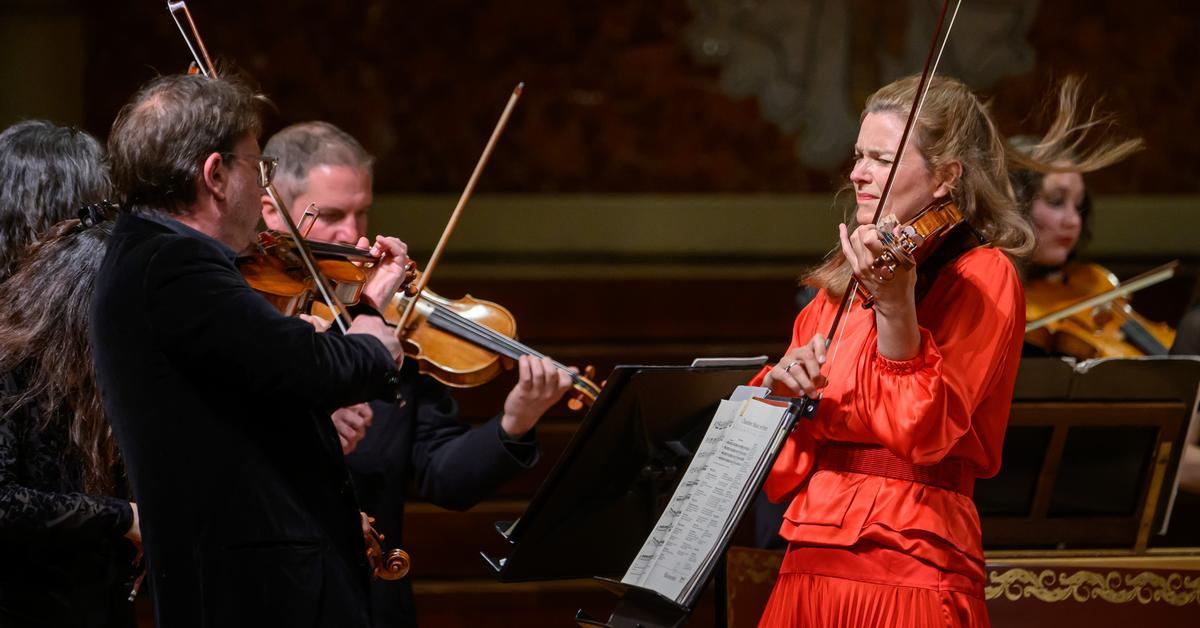
- Palau de la Música. April 29, 2026
We have said and written on other occasions, when faced with well-known and over-interpreted repertoire works, that it is surprising that they can still say new things from the always ambiguous concept of interpretation. But yes, it is possible: and if in January Vivaldi’s “The Four Seasons” seemed freshly baked in the hands of Vespres d’Arnadí), now – thanks to the violinistic voice of Janine Jansen, supported by the Camerata Salzburg – the four famous concerts of the Venetian musician have sounded as new. In this case, thanks to the precise and imaginative virtuosity of the Austrian string ensemble and the contagious enthusiasm of the Dutch violinist, integrated into the ensemble and with a permanent, enthusiastic dialogue far removed from the individualism of a diva embracing her 1715 Stradivarius.The precise attacks, the timbral intensity, and the measured improvised passages have brought new light to works that, beyond their advertising use, are masterpieces of musical craftsmanship. And so they sounded on the stage of a Palau de la Música packed to the rafters – even to the organ galleries – and with the burden of a mobile phone that, impertinently, wanted to have its say at the end of La tardor.The evening, however, was not limited to Vivaldi and his most iconic work, but rather to a review of the concept of concerto grosso, typical of the Baroque, but which in the 20th and 21st centuries can also find its place within chamber music: Nino Rota and his Concert per l’archi opened the show, with the mellow strings of the Camerata Salzburg led by a Gregory Ahss always attentive to his stage companions, and with precise gestures to mark accents in the service of a delightful work.The Palau premiered the Piccolo concerto grosso, op. 87 by the Franco-Swiss Richard Dubugnon (1968), present in the hall and who has dedicated the piece to Janine Jansen. The successful and effective use of staccati revealed Jansen’s virtuosity and her rapport with Ahss’s violin, along with Firmian Lerner’s viola and Stefano Guarino’s cello, and throughout twenty minutes of good music. The almost jazzy passages of the first movement, with their syncopated rhythms, brought to light the expressive uniqueness of the instrumental ensemble, with a masterful performance from its members.
