



The number of visitors to Papua New Guinea rebounded strongly in 2022 and 2023, largely driven by the reopening of international borders following COVID-19 travel restrictions. This recovery reflected pent-up travel demand, resumed airline operations and the gradual return of business and leisure travel.
By 2023, total air arrivals had reached 70% of their 2019 pre-COVID level. However, in 2024, total air arrivals declined by approximately 11%, interrupting the recovery trend. Arrivals data for 2025 have not yet been released, but first-half-year data indicates a slight recovery from 2024, with a 10% increase in the first six months of 2025 relative to the first six months of 2024. Overall arrivals are back at their level of almost 20 years ago.
The above figures are for all arrivals by air, whatever the reason. If we want to look just at tourists, we need to look at both those who arrive by air and those who visit on a cruise. Before the pandemic, the number of tourists arriving by air had fallen, but the number arriving by cruise ships had grown dramatically. According to an official industry report, Australia is the largest cruise source market in the world on a per-capita basis, with the South Pacific and Papua New Guinea among their preferred destinations. Neither category — air or cruise — has fully recovered since the pandemic. By 2024, both had reached slightly above half of their immediate pre-COVID peak.
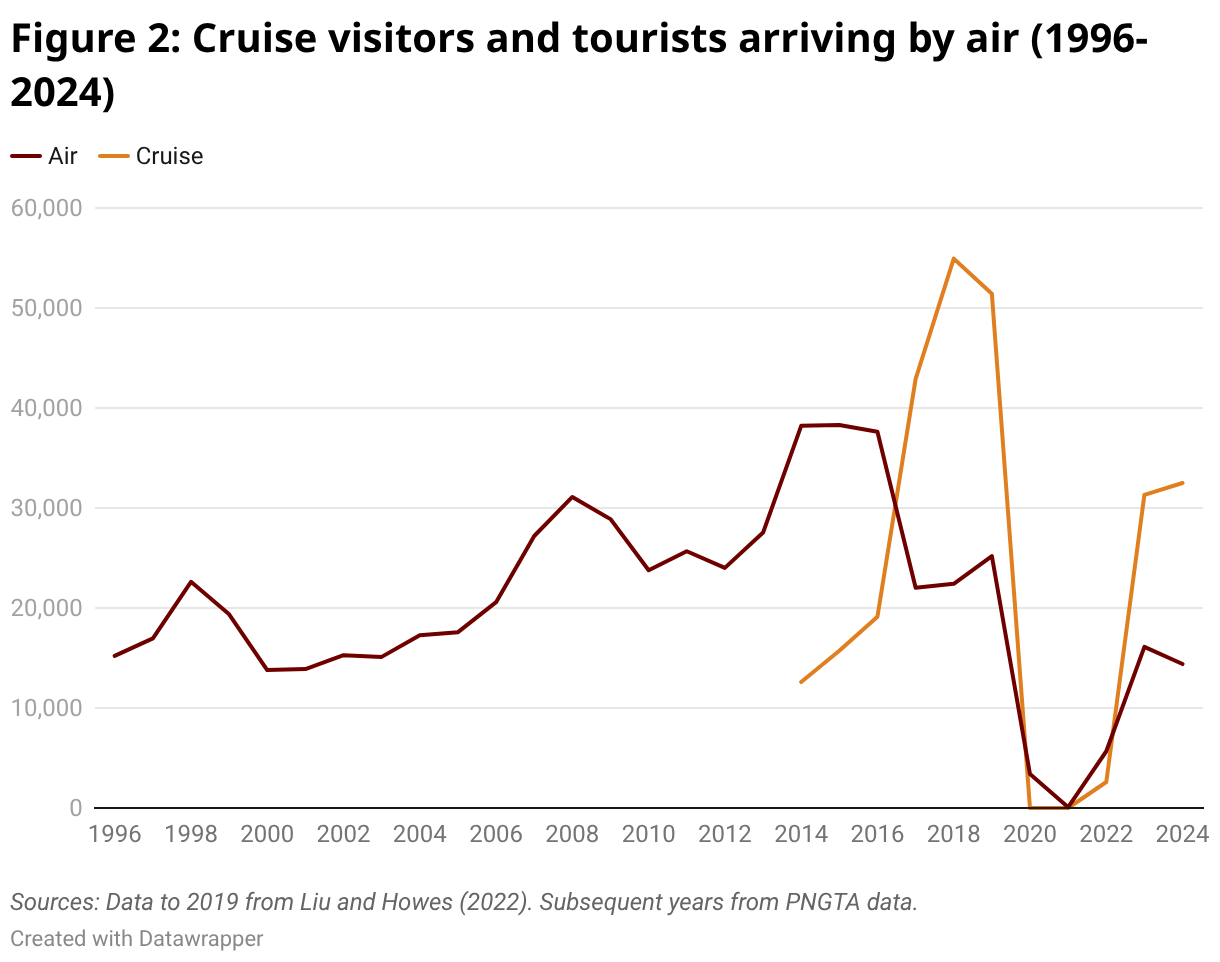
Why has the post-COVID travel and tourism recovery been only partial? As the 2024 PNG Tourism Promotion Authority (PNGTPA) report notes, the 2024 downturn was likely the result of law and order challenges, particularly in East New Britain, a popular cruise ship destination, and “Black Wednesday” in Port Moresby on January 10th, which negatively affected perceptions of safety and stability. These events likely weakened traveller confidence and reinforced PNG’s long-standing image as a high-risk destination.
To get a deeper insight, we can also look at how visitors to PNG have changed by province, type and nationality.
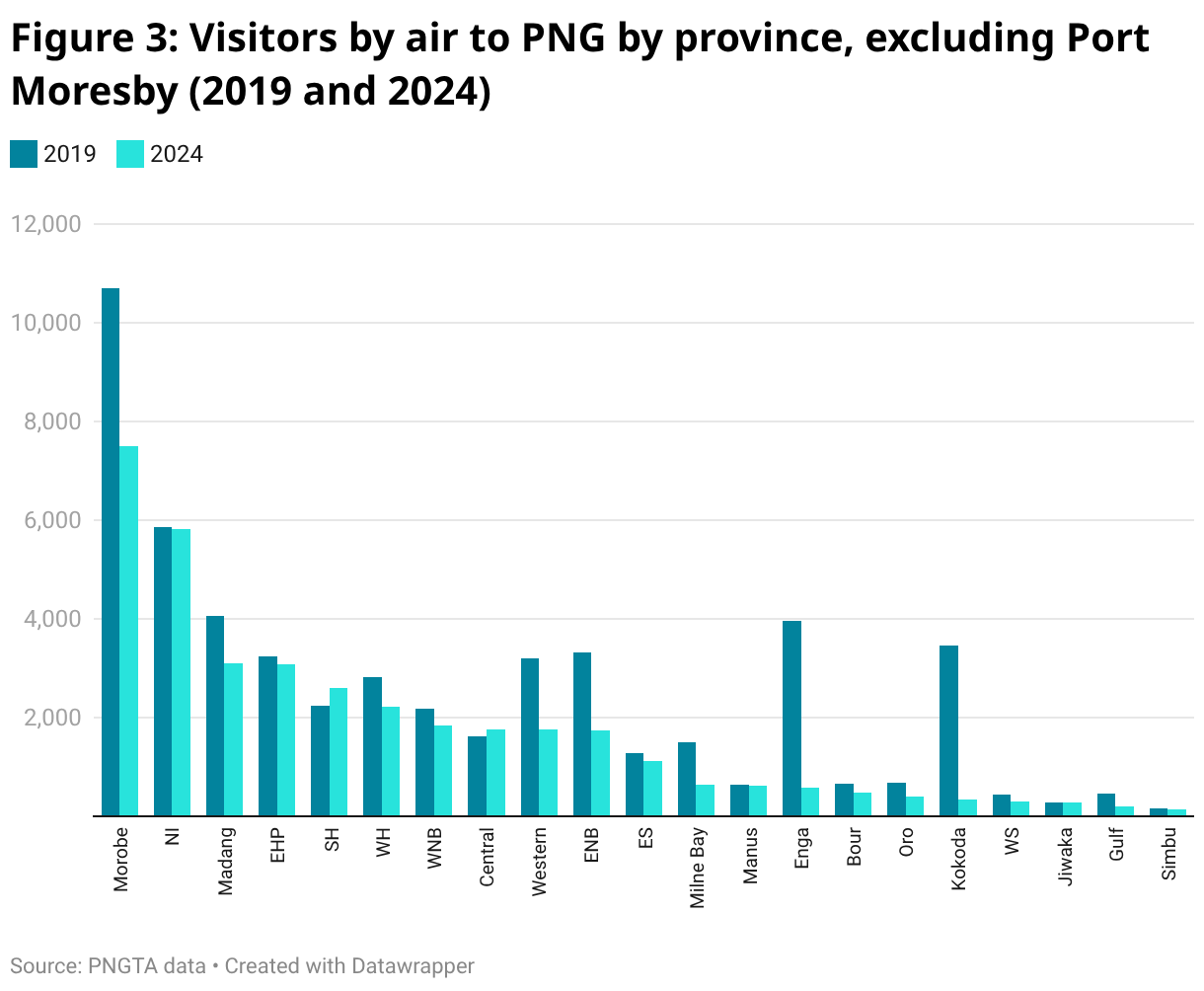
About two-thirds of air arrivals are classified as visiting the nation’s capital, Port Moresby. The remainder are divided by province in the figure below, before and after the pandemic. (Visitors to PNG have to declare their “intended address” and presumably these numbers are based on their answer to this question.) Most provinces (including the National Capital District that contains Port Moresby) show a large decline in visitors, though a few provinces have bucked the trend (Southern Highlands, Hela, Central and Jiwaka all show a small increase). Visitors to Kokoda have fallen precipitously from 3,466 in 2019 to 340 in 2024.
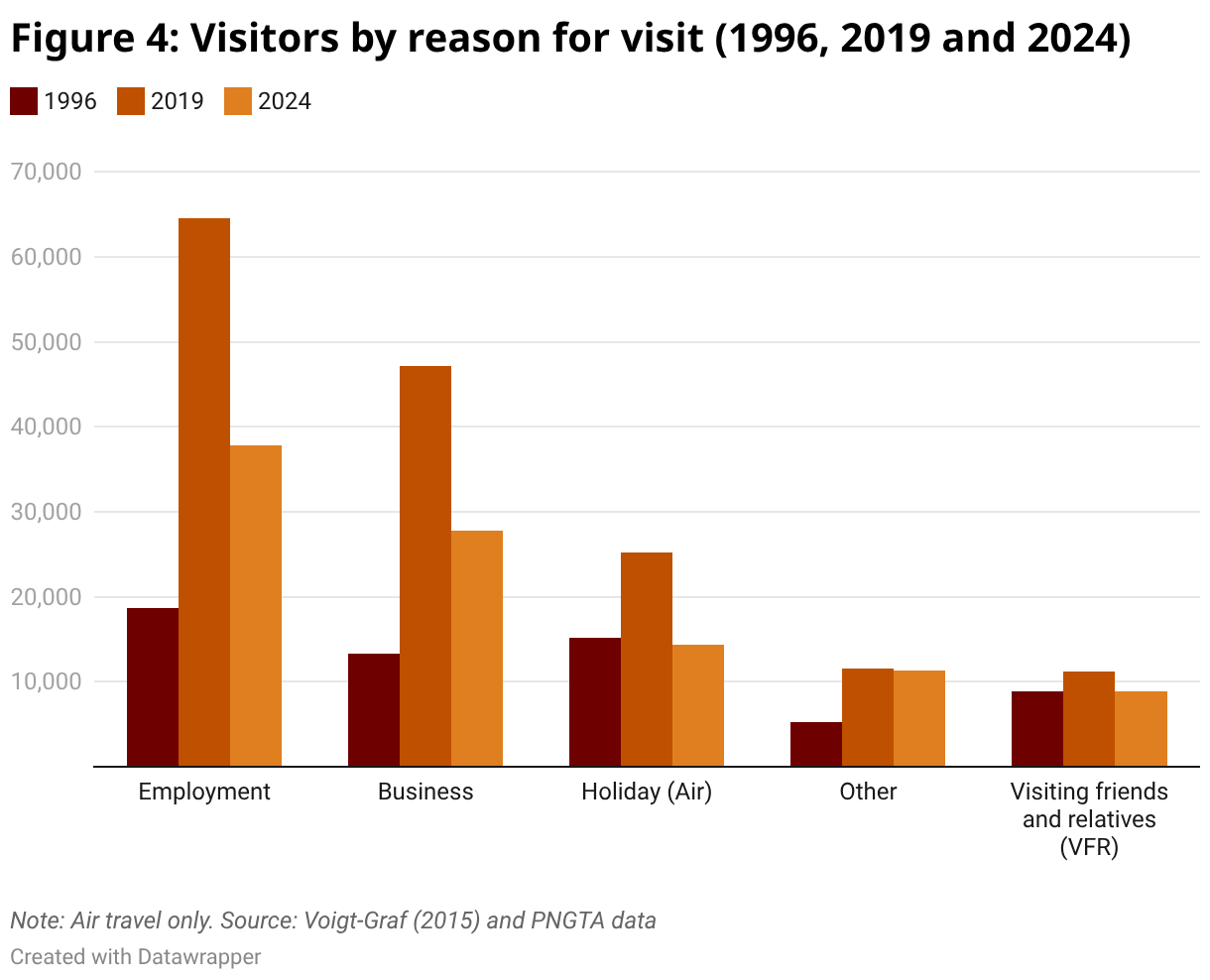
Turning to reasons for travel, the major categories have all fallen since the pandemic: employment and business have fallen by 41% compared to 2019, tourists arriving by air have fallen by 43% and those visiting friends and relatives (VFR) have fallen by 20%. However, we can go back as far as 1996. Compared to then we see many more travelling for employment and business, but the same number of tourists.
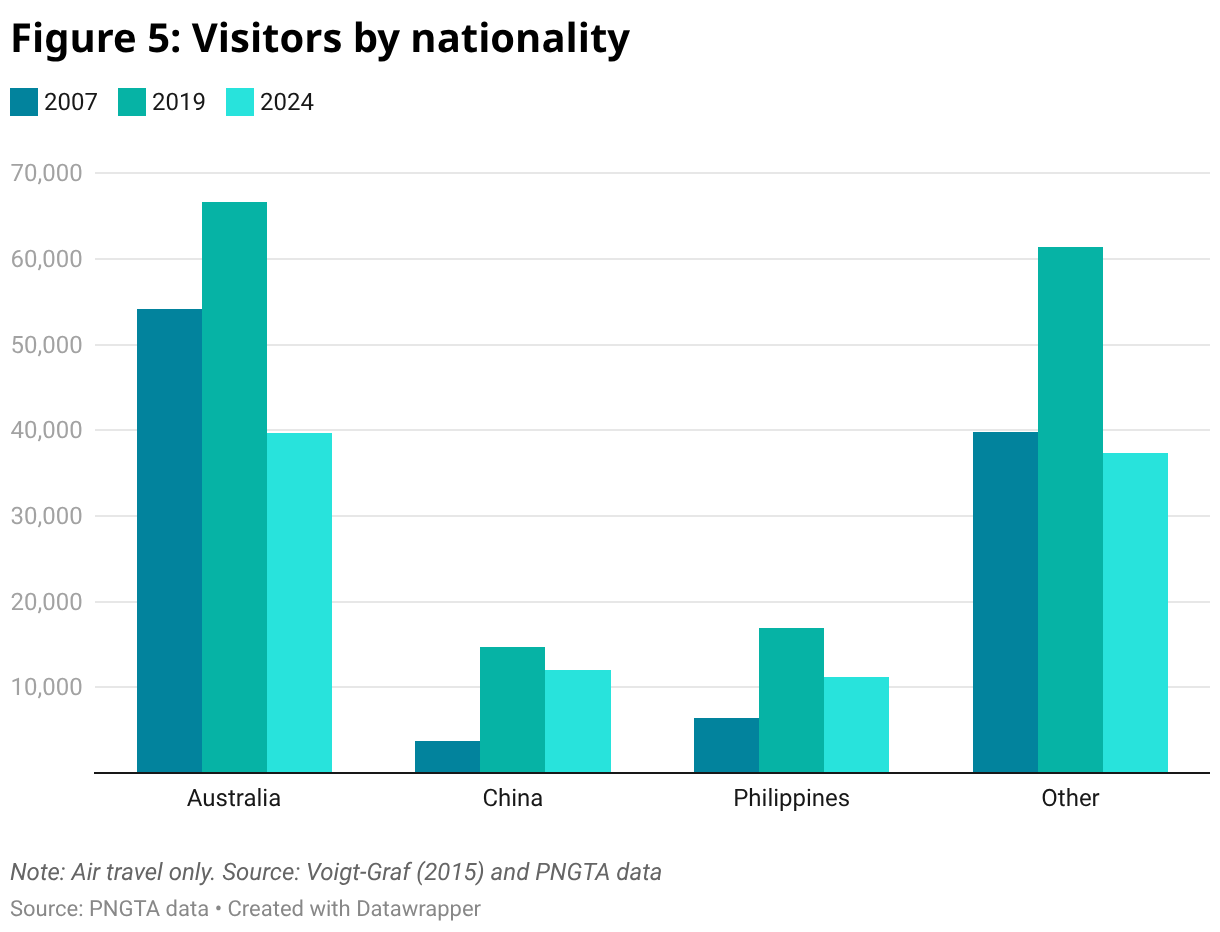
Finally, we can look at the composition of PNG’s visitors by nationality. Australians used to be half of all visitors to PNG, but this share fell to 40% just before COVID, which is where it is now. China and the Philippines are the second and third most important source countries. The number of visitors from both countries also fell between 2019 and 2024, though not by as much as the number of Australians. Visitors from other countries have also fallen significantly.
Longer term, there is certainly a shift away from Australia as a source market, towards Asia. Our data by nationality starts in 2007. Up to 2012, Australians made up half or just over half of all visitors to PNG. That percentage fell into the forties in the few years before the pandemic and is now just below 40%. By contrast, the share of visitors from China and the Philippines has increased from around 20% before 2010 to 30% just before the pandemic and currently. Interestingly, Australians continue to dominate business and holiday air travel (making up about half of each; and much more than half of the cruise market) but are much less important in the employment segment where Australians make up only 28% of all visitors travelling to work.
Figures for the Asia-Pacific region indicate that visitor arrivals for the region as a whole in 2024 were at 92% of 2019 levels. PNG’s recovery is significantly slower than this, with post-pandemic recovery only reaching 60-70% of pre-pandemic levels. Our data dive reveals that there is no single reason for this. The smaller number of visitors to PNG in 2024 relative to 2019 is evident whether we look at the purpose of travel, at arrivals by air or by cruise, the destination of travel within PNG, or the nationality of travel.
The lack of progress in visitor numbers since 2023 is worrying. Reversing this trend requires a coordinated approach led by government, with strong collaboration among key tourism stakeholders. As tourism is everybody’s business, responsibility must be shared across all sectors. Priority should be given to improving infrastructure, strengthening marketing efforts and, most critically, enhancing safety and security.
