

Small to medium-sized businesses (SMEs) in Papua New Guinea are calling for more support to allow them to grow and promote PNG-made products.
PNG’s economy is concentrated at one end on major resource extraction industries, and at the other on economic activity in informal, grassroots markets from which many people earn a small living.
But somewhere in the middle are the homegrown SMEs struggling to stay afloat, employ locals and truly build the inclusive economy that the government says the country can have.
RNZ Pacific spoke to the owners of three SMEs in PNG to find out what sort of pressures they face and what it takes for them to grow.
Overcoming barriers
Sylvia Pascoe is the founder of Pascoe Events and Marketing and the POM City Markets in Port Moresby, which has operated for almost nine years.
It grew from an occasional market supporting about 30 SMEs in arts and crafts, weaving, agriculture and other sectors, to near-weekly markets across the PNG capital.
Pascoe told RNZ Pacific that being a PNG woman leading an SME means a bunch of hurdles to overcome from the outset.
“Constantly people kept reminding me that young PNG women didn’t belong in business, that it was something I should steer away from, that if I’m going to get into business, the common thing people would tell me is: hire a white person to be the face of my business.
“And even to the point that, I would look for accountants, and at that time, accountants, banks, everything was set up for big business,” Pascoe explained.
“So when you knocked on the door and said you needed help as a small business, the people quickly shut it in my face.”
Port Moresby Night Market
RNZ Pacific / Johnny Blades
She said that once her business reached a level of success, other small businesses approached her asking how they could access customers like her business.
“Eventually, I got so many knocks on the door, I said we’ve got to come up with something else to suit this need. And so we started POM City Markets.
“I just thought it’ll just be a market atmosphere, it’s easy enough, people understand, just trading stuff openly, there’s no there’s no pressure in that- and we had the gear to do it.
“So, we started, and I thought to myself, oh, maybe we’ll help like thirty SMEs once a year, once a quarter perhaps. And literally, from the first time we set up, we had over a hundred calls saying, how can we get in there?
“And then I realised there’s just such a huge space for people that again, just like me, starting out, they just want to be seen. They just want to be connected to people.
“So I kind of found a space bridging that gap between those that could be customers that didn’t know where to find all these SMEs.”
Compliance
QRF Limited is another PNG-owned SME operating in the ICT sector and provides security, communications, and other services, with a current headcount of 20 permanent, contracted, and casual employees.
It clients include some big players such as government and corporates, including particularly in logistics, mining, and oil palm.
QRF managing director Heni Sarwom said SMEs can benefit from being able to get contracts with some of the major corporate companies operating in PNG, but it is difficult to reach that position.
“It’s an awareness thing that, you know, many people are not aware of. So, when they try to compete for a tender or a bid, usually, they’re they they can’t make it because they don’t meet those basic compliance.
“And there are many compliance (requirements) that are needed to actually get awarded one of those contracts,” Sarwom said.
“With QRF, that’s the exposure we’ve got to make sure that we are compliant to all the statutory requirements and also international standards where it’s applicable.”
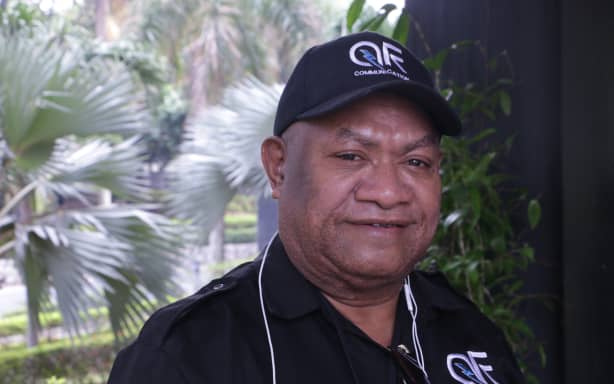
QRF’s managing director Heni Sarwom.
RNZ Pacific / Johnny Blades
Finance
Getting finance to build a small to medium business in PNG is always a challenge, Sarwom said.
“In the industry that I am now participating in, there’s a huge capital investment in there to build infrastructure. That type of investment doesn’t come easy, especially when we think there is funds available in the bank for SMEs, and then it’s very difficult to access those funds.
“So, we basically use what we have to build, and then slowly build layer by layer of our infrastructure.”
The government recently initiated an investigation into alleged maladministration relating to a 200 million kina (NZ$81.5m) fund set aside to support local SMEs get established.
Sarwom said QRF’s initial enquiries found the fund was unavailable at that time.
“But I haven’t gone back, because you tend to get discouraged when you go, the first time, the second time, and the third time, and then you just say, ‘okay, let’s work on what we have’.
“There are other smaller financial institutes that are around who are giving out loans, but their [interest] rates are pretty high. So I don’t think it’s advisable for me to actually consider one of those, because it will kill the business model.”
Global forces
Maku Gifts is an 11-year-old PNG gift and fashion business with nine locations and about 120 staff, founded and run by Annette Sete.
It is a homegrown project that is up against the global market in more ways than one.
“Business is a bit slow. The PNG kina has been devalued. We get almost 70 percent of our products or raw products, that is materials through imports. So that’s a massive, massive challenge for us.
Sete said many of her employees come from the village setting who do not always have the type of skills required at the start.
“The positive side is there’s a lot of creative people from the ground up, so we do get to make some nice things that different from what’s being offered, different from what the market is making and producing out of China and supplying.
“So it helps us in terms of making a point of difference in in our products,” she told RNZ Pacific.
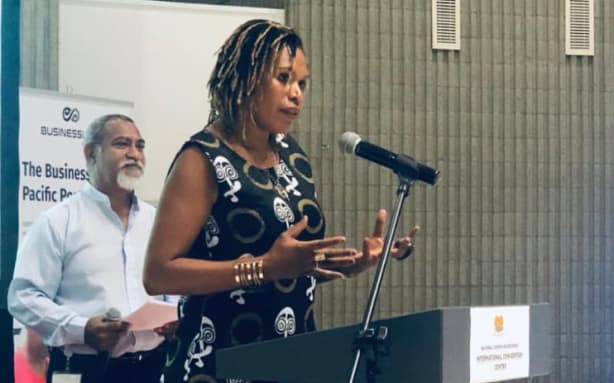
Annette Sete of Maku Gifts
But despite that point of difference aside, Sete said that all too often sectors that are meant to be reserved spaces for PNG businesses are being flooded by foreign-owned business interests.
“For example, we produce fabric, or design fabric, we print and bring it in-country. We make a national meri dress for women. You have Chinese businesses bringing meri blouses and sewing meri blouses, and like, that’s not on,” Sete said.
“This is our dress. You should not be selling dresses. You know, it states that their shop floor has to be less than 500 square metres in order to sell some of these PNG items. But it’s not being policed.
“Like people don’t go in there and have a check at what their floor size is, what they’re selling. So we’re just out there competing, trying to survive.”
Creating spaces
Sarwom said hard work and perseverance are essential prerequisites for an SME to survive, adding that he would like to see more corporates give homegrown SMEs a chance for contracts.
Sete would like to see growth capital made available at reduced interest rates, fairer or specialised taxation, lower import duties on materials that SMEs use, and compliance relief during growth periods.
Pascoe said she would like to see government better fund spaces that SMEs can access to grow their businesses.
“Right now, almost every major mall in town is not PNG owned, and even the ones that are, you won’t see a lot of PNG owned businesses in them.
“They need to create spaces that SMEs can afford to move into,” Pascoe said.
“And it could just be partnering with people that are doing markets and things like that to build something, or I would appreciate them building more warehouses, more office blocks, and just saying this is specifically for people that meet this requirement as an SME, they can access this.”
