


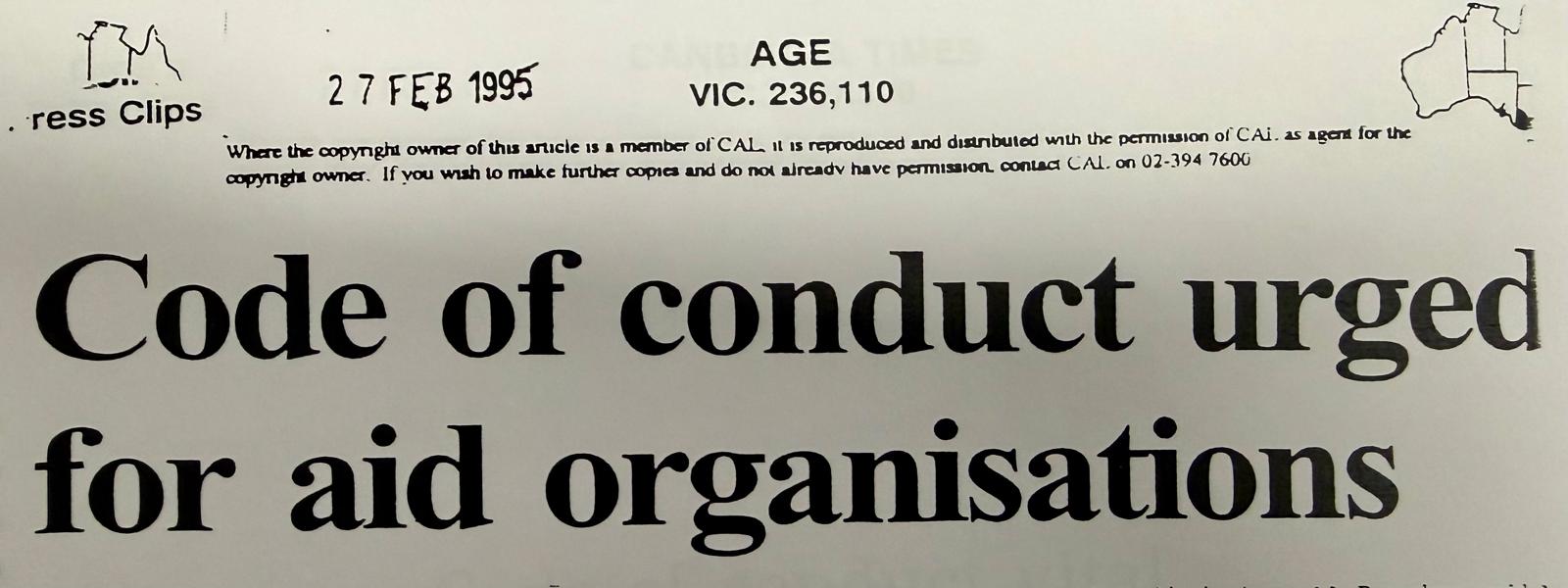
This article recounts, as a lesson-learning exercise, a chain of events that played out in the 1990s — financial misconduct occurred, allegations were made about it, the response was weak, audits were launched, followed by a TV exposé, and finally a sector code of conduct was adopted.
It is written from my perspective as an NGO employee and then reluctant whistleblower. A longer report published today by the Development Policy Centre provides a more detailed account.
The key player in this story — CARE Australia — is now a respected and trusted NGO. It would be wrong for these reflections to be used against today’s CARE Australia. But there are certainly lessons in this story for today’s aid sector.
In 1989 I accepted a job offer from CARE Australia. I started in June 1989 and lasted 19 months. After becoming a whistleblower in January 1991 I couldn’t get work in Australia with another NGO and went back overseas.
CARE Australia was established in 1987 and from the outset a substantial proportion of the funds raised as grants and donations was used to cover its own costs. Whether CARE’s leadership wanted to recognise it or not, this involved — as I saw it then and still see it — fraud on the Commonwealth and a breach of trust with the public. I came to understand that from its inception CARE’s leadership had been massaging grant budgets and acquittals to generate surpluses to help pay for overheads.
Things came to a head in mid-1990 on a monitoring mission to Africa when I got evidence that CARE was overstating costs. My contact in the procurement company acknowledged the difference and told me it was CARE, not the contractor, that was making the margin.
I got back to Australia in late December 1990 to find my position had been abolished. I wrote to CARE’s board on 7 January 1991 alleging that CARE had received grant money from the Australian Agency for International Development (AusAID) that exceeded actual requirements for the transportation of relief maize ex Zimbabwe. The “savings” involved were approximately $1.25 million.
Former Prime Minister Malcolm Fraser, as chair of the board, rang me at home and sought to justify the retention of the “savings” on the claimed basis that this was standard practice. I pointed out that the grants were fully acquittable. At this point Fraser threatened me, noting I had a young family and that he would make sure that I would never get another job in Australia if I went to the government with my allegations.
A few days before writing to the board, on 3 January 1991, I had gone to AusAID. The relevant section head expressed concern, but in late February AusAID informed CARE and the relevant Minister, then Neal Blewett, that it was satisfied with CARE’s handling of funds, even though AusAID had not inspected CARE’s files and accounts. The Australian National Audit Office (ANAO) later said AusAID “should have been more assiduous in its inquiries”.
An officer of the Australian Council for International Development (ACFID) suggested I contact the ANAO. I then left Australia and didn’t have further contact with them until January 1993 — at which time I was told my information had proved spot on, that it was clear CARE Australia had been diverting funds, and that AusAID’s unwillingness to look closely into all of this “left something to be desired and we will be saying so”.
After I took my allegations to the ANAO, AusAID identified over $440,000 that CARE had not spent for approved purposes. But AusAID did not make this public, and in May 1992 Minister John Kerin agreed to allow CARE to offset most of the amount against monies provided for a new refugee relief program. This pattern was repeated in 1994 when AusAID identified that CARE had accumulated over $1 million as surplus funds and allowed CARE to quietly transfer the surplus to new approved projects.
By May 1994 I had resolved to go public and contacted Four Corners. Ross Coulthart said he was keen but asked if I would be comfortable if he pursued the story via Channel Nine’s Sunday team, which he was about to join. An exposé aired on 26 February 1995. The major newspapers featured the story in the following days.
AusAID had commissioned an audit by BDO Nelson Parkhill to investigate my allegations. On a Mozambique food aid project, where I had said costs were overstated by “over $200,000”, BDO found my allegation “supportable” and put the overstatement at $208,000, which CARE refunded. On a Sudan health project, BDO found the budget had been overstated by $30,000, which CARE also repaid.
BDO acknowledged that “CARE appears to have on occasion not applied public donations, for various reasons, to projects in accordance with fundraising campaigns.” Minister Bilney stated: “Practices such as overstating acquittals, padding budgets and diversion of funds are totally unacceptable to the Government.” The Attorney-General advised Bilney to refer the matter to the Director of Public Prosecutions (DPP). But no charges were laid. Set against the $1.25 million I had alleged was overstated and the more than $1 million in accumulated surpluses AusAID itself had identified, the total recovered by government was only some $238,000.
ACFID made its case for self-regulation and this view prevailed, it being agreed that there would be a voluntary, self-regulatory sector code — which is now the ACFID Code of Conduct — and crucially that signing it would be a condition of NGO accreditation with AusAID. The Code was finalised in 1997. Under new management CARE belatedly joined ACFID and signed the new Code of Conduct.
The CARE saga demonstrated that the three key ingredients for financial misconduct are cynicism, opportunity and a strong disincentive to unearthing it. I believe the sector remains vulnerable because its legitimacy rests so much on trust, it remains difficult to follow the money in disaster settings, and disincentives to exposing serious financial wrongdoing persist — commonly where it would reflect poorly on government, contractors or NGOs for not preventing it or acknowledging it earlier.
It is remarkable that in the 30 years since the front-page reporting in 1995 there hasn’t been another scandal like it. Does this mean that in three decades there hasn’t been any financial wrongdoing that if known would be all over the news? If there has been, then either it is not being detected, or it is not being made public when it is.
My sense is that the sector is not sufficiently proactive in looking for and finding fraud and is instead over-reliant on inherently weak audit processes. And I believe the limited reporting made available by the Department of Foreign Affairs and Trade and the ACFID Code of Conduct Committee does not enable the public to gauge how effectively the risk of financial wrongdoing is being managed in the delivery of Australian assistance.
