



Australia introduced the second-year backpacker visa extension in 2005, enabling backpackers to extend their stay for a second year in return for 88 days of specified regional work in the first year. Farmers were complaining about workforce shortages and the Howard government was unwilling to agree to a Pacific seasonal worker program.
The Morrison government announced the third-year backpacker visa extension, to be given in return for six months of regional work in the second year, in 2018. At the time, farmers were complaining that the Pacific seasonal worker program introduced in 2008 wasn’t good enough, and were agitating for a dedicated agricultural visa.
Most of the regional work undertaken for the second- and third-year visas has been in agriculture, and the backpacker visa has become a de facto regional, and in particular agricultural, work visa. The numbers are now huge. Extensions granted in return for regional work rose from 26,400 in 2022–23 to 54,900 in 2023–24 and almost 90,000 in each of the last two years. The third-year category has grown fastest, from 7,600 in 2023–24 to 31,500 in 2025–26. UK visas issued are excluded from these numbers from 2024–25 as UK backpacker visa extensions are exempted from work requirements under the new Australia-UK free trade agreement.
In his press club speech on 17 September, the Minister for Home Affairs Tony Burke announced caps on second- and third-year backpacker visas granted in return for specified regional work (so excluding UK nationals): 45,000 for the second year and 5,000 for the third, to be allocated by lottery. This is a cut of 44% compared to the visas issued in 2025–26.
Labor’s 2023 Review of the Migration System recommended abolishing both extensions; Labor has now substantially done so for the third year. Yes, it has left 5,000 spots. But an 84% cut is not far from 100%.
This is a much more radical reform than the ones I had anticipated when Labor flagged backpacker visa reform in this year’s budget (though others were closer to the mark).
One puzzle is why Labor didn’t abolish the third-year visa altogether. Perhaps that was politically infeasible given employer opposition. The risk is that a quota of 5,000 can be easily and rapidly increased, and might well be when there is a change of government. The Nationals have already come out against the cap.
Nor is it clear how the lottery will work. Will there just be one a year, or one a month? Will applicants be able to apply more than once for a backpacker visa extension lottery? Whatever arrangements are put in place, it will surely lead to delays in transitioning to the second and third visas.
What will the impact be on the agricultural workforce? One way to calculate the number of backpackers working in agriculture is to sum the backpacker visa extensions granted on the basis of agricultural work. This was 42,000 in 2024–25, the most recent year for which data is available. Alternatively, we can take an industry estimate. The National Farmers Federation says that there are 52,000 backpackers working in horticulture alone.
How much the reforms will impact the number of backpackers working in agriculture is even more difficult to say. It is impossible to judge the behavioural response of backpackers to these changes. (There have been too many changes over time to isolate and model the impact of this particular reform.) Some backpackers will want to work on a farm in their first or second year even if they are not guaranteed a second- or third-year visa. On the other hand, fewer backpackers may come to Australia once the rewards from work are reduced, and fewer may work for long enough to qualify for the visa extension. Also, if there are shortages, workers may move off farms to undertake other regional qualifying work, say in tourism.
So there is a lot of uncertainty. If, for simplicity, we assume that the 44% cut in visa numbers becomes a 44% reduction in the number of backpackers working on farms, and we apply this to the lower of the two estimates presented above, we arrive at a a reduction in backpackers working on farms of 18,300. The impact in terms of backpacker hours could be greater, given that the cuts are focused on the third-year extension which has double the work requirement of the second-year extension (six months versus three).
How will this gap be filled? With the growth in backpackers and increased regulation of the Pacific Australia Labour Mobility (PALM) scheme, the number of short-term PALM workers (nearly all of whom do seasonal work on farms) fell over 2023 and 2024 and has since stabilised at around 16,000. Another approximately 3,300 long-term (non-seasonal) PALM workers also work on farms.
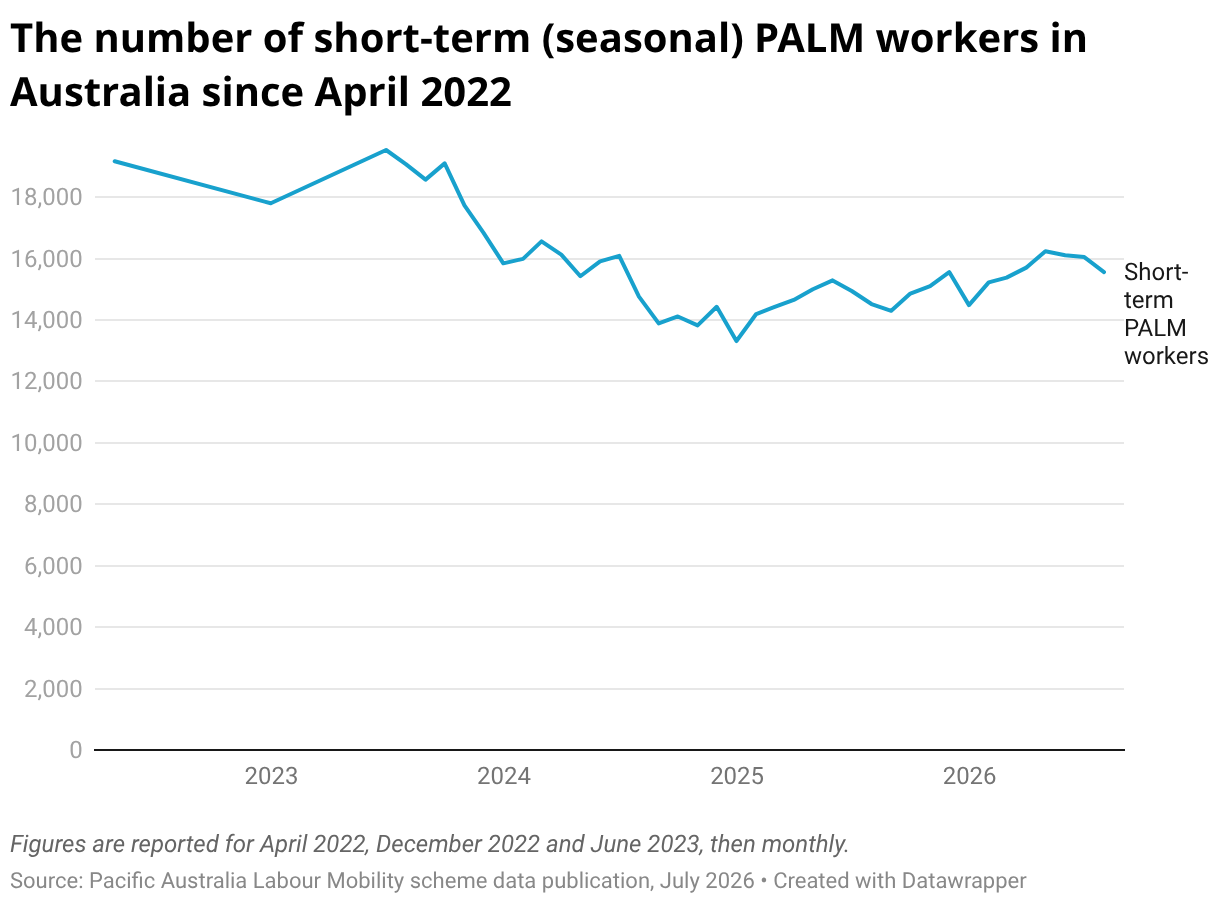
PALM workers and backpackers are by no means perfect substitutes. Backpackers are a much more flexible source of labour. Employers can hire them a day at a time, and need no government permission to do so. We also lack an estimate of how long the average agricultural backpacker works for. Some do just the minimum for the visa extension, others work year round.
So, while the backpacker reforms will clearly lead to greater demand for PALM workers, it is not possible to convincingly quantify by how much. Other Australians and temporary migrants such as international students are also likely to do more work on farms. That said, a simple comparison of the cut in backpacker visas with current PALM numbers is enough to indicate that this reform represents a significant opportunity for PALM.
I described the introduction of the third-year backpacker visa in 2018 as a “Pacific step down”. Certainly, last week’s announcement is a big Pacific step up.
In the face of employer opposition, a strong narrative is needed to support these reforms. It can only partly be about reducing net migration since, as already noted, some proportion of the gap left by fewer backpackers will be filled by more PALM workers.
When the 2023 migration review recommended abolishing both backpacker visa extensions, it did so because the work requirement was “a key driver of exploitation” (page 89). It had plenty of evidence. A decade ago, the Fair Work Ombudsman found that the scheme’s “work-for-visa system is broken” and that there was “an environment of unreasonable and unlawful requirements imposed on visa holders by unscrupulous businesses”. A 2017 University of Adelaide study found that backpackers were more likely to be exploited than Pacific seasonal workers.
Minister Tony Burke has already leaned into this line of argument by saying that farmers shouldn’t try to avoid the highly regulated PALM scheme by hiring backpackers and that the sector shouldn’t be reliant on “worker exploitation”.
After 20 years of reforms that have made the backpacker visa more and more like a temporary worker visa, last week’s announcement was the first significant move in the opposite direction. While questions remain over the durability of the new caps, the government should be commended.
Note: Backpacker visas include the 417 Working Holiday Visa, for rich countries and uncapped, and the 462 Work and Holiday Visa, mainly for poorer countries and mainly capped.
