

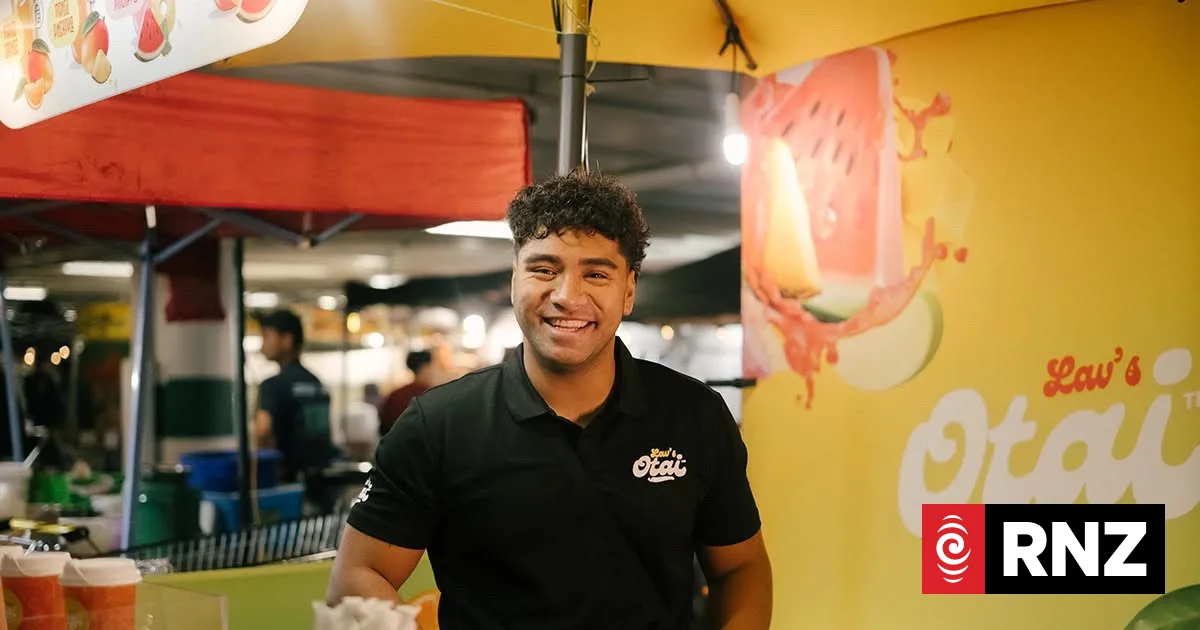
Over the years, 21-year-old Siaosi (George) Lavelua (Kolomotu’a, Makave) has often made the trip north to the Waitangi Treaty Grounds with freshly made ‘otai in tow.
His whānau business, Lav’s ‘otai – dealing in the much loved Polynesian drink that typically mixes coconut and fruit – is the longest-serving ‘otai operation in Tāmaki Makaurau.
It has become a familiar fixture at Waitangi celebrations, Auckland night markets and various community events across the region.
“It’s something I’ve grown up around my whole life. Wherever there’s a big event, we’re usually there serving ‘otai and meeting people,” Lavelua said.
Over the years, events such as Waitangi have become extra special for Lavelua – a Tongan who has dedicated over five years of his life learning te reo Māori.
“When I was able to go up there (Waitangi) and then converse with a bunch of different people in te reo Māori, just seeing the connections and friends and people that you can make just through speaking te reo, it definitely, yeah, made me very appreciative to be able to learn the language,” Lavelua said.
Lavelua grew up in central Auckland, speaking Tongan at home with his parents.
Siaosi (George) Lavelua serving ‘otai for his parents business, @lavsotai
Geoffery Matautia
His reo journey began as a year 9 at Auckland Grammar School, and was initially an opportunity for him to spend class time with other tauira Māori and Pasifika.
“For the first three years of my schooling, in every other class except Te reo Māori, I was the only, like one or two Pacific or Māori people in my classes,” Lavelua said.
“I just wanted to be with other people from the Pacific, and so then I took te reo Māori.”
Lavelua loved it so much that he stuck it out until year 13, and quickly realised the merging similarities between the Tongan language and the Māori language.
“As I started to learn the language, I noticed that there were so many similarities in terms of, like, old Tongan,” he said.
“There was quite a lot of words or the same sentence structure that mirrored exactly what I was learning, what I speak at home. And so it just made my journey a whole lot easier.”
While it wasn’t an ‘easy journey, Lavelua said it was well-worth the investment.
Crossover
Online, he has began sharing content speaking te reo Māori.
People often comment on how impressive his trilingualism is, something Lavelua said reinforced his own appreciation for the Tongan language.
“Since I grew up speaking Tongan, it was always sort of something on like a back burner, it wasn’t necessarily something that I thought too much about,” Lavelua said.
That changed as he watched how people responded to his reo, including Māori who frequently tell him of their desire to learn and speak their own language one day.
“It’s really a deeper love for my own language and my own culture. And just seeing how blessed I was to retain that.”
“Growing up, I’ve always had such a deep respect for the Māori culture and Māori people,” he said.
“I think it’s a beautiful thing what Māori had done here in New Zealand, and Aotearoa, being able to retain the culture and traditions and languages, even all the way up to religion, and that’s something that we certainly didn’t really have in other parts of the Pacific, being very Christianised and things.”
The values between cultures cross over, too, Lavelua said.
When asked which te ao Māori principles resonate, he landed on whanaungatanga.
“Hospitality and that sort of relationship they have with other people…it’s about the home, it’s the relationships of those around us, the community, the environment,” he said.
And Lavelua said that point is one of the real lessons he came to learn while learning te reo Māori.
“There are some people who very distinctly categorise Māori and Pasifika as two separate categories, or two separate people,” he said.
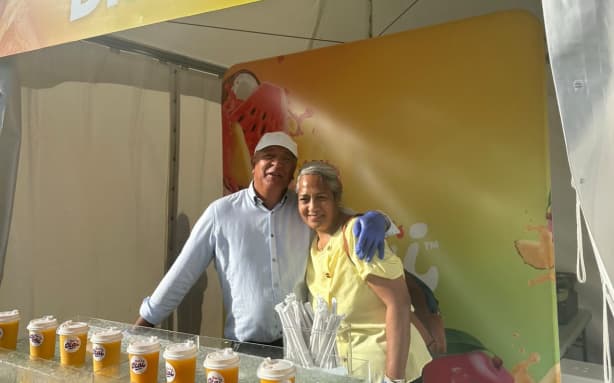
Siaosi (George) Lavelua’s whānau @lavsotai
Siaosi (George) Lavelua
“But then definitely through learning te reo and learning a lot more about the culture, you really see that overlap and like that true understanding that you actually are one people at the end of the day.”
One of the biggest surprises on his journey so far has been understanding the historical relationships between Pacific and Māori.
Lavelua began reading Pacific history, and came across accounts of Pacific sovereigns – he points to King Tāwhiao, alongside Tongan and Hawaiian royalty – who would write to one another as colonisation took hold.
“They all had actually been writing letters between each other to sort of help each other maintain their own sovereignty,” he said.
” Seeing that back in the day, specifically with these leaders that we had in our communities, it was definitely heartwarming to see and really opened my mind on just how interconnected the Pacific really is, and how interconnected the Pacific should be.”
Journey
Now based in Brisbane, working across marketing and hospitality, Lavelua said distance from Aotearoa has sharpened the meaning of events such as Te Wiki o Te Reo Māori, and what they mean to him.
It’s a good reminder, he said, to celebrate the week, identity, and community.
He also has advice for other Pasifika and non-Māori who are thinking of undertaking their reo journey.
“Just give it a crack, just give it a go. I don’t think that anybody can ever be perfect in a language. I definitely wasn’t perfect when learning te reo Māori, I’m still not perfect at this point, but that’s definitely something that holds a lot of people back.
His favourite whakataukī encompasses this message well.
“Tūwhitia te hopo, mairangatia te angitū! Feel the fear and do it anyway. I think that’s fitting when it comes to learning languages, or anywhere in life.”
