


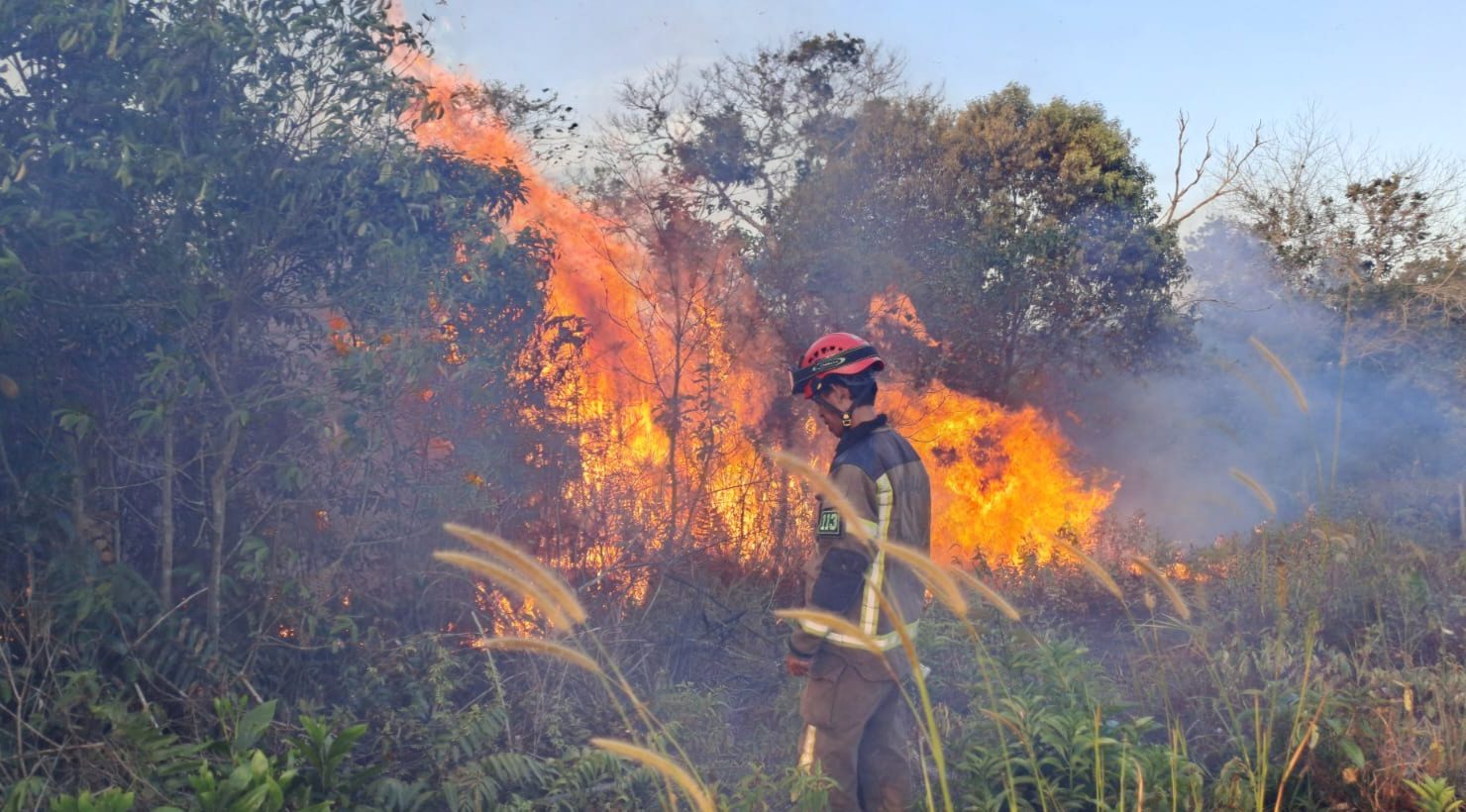
Forest and land fires, or karhutla, have returned to the Indonesian archipelago. Roughly 202,000 hectares of land and forests burned in 2026, with Kalimantan once again among the areas affected. Since July, hotspot activity in this region has risen sharply, reaching its peak in August. Thick haze disrupted flights, worsened respiratory risks and exposed schoolchildren to hazardous air while classes remained open.
El Niño is a part of the explanation. Indonesia’s Meteorology, Climatology and Geophysics Agency (BMKG) reported that by early August 76.5% of Indonesia had entered the dry season, with El Niño at very strong intensity and still strengthening, expected to persist into early 2027. Drier conditions make vegetation and peatlands more flammable and harder to control.
However, the recurrence of fires points to a longer-standing problem. These episodes have repeatedly been linked to land clearing, degraded peatlands, agricultural expansion and weak enforcement. In 2015, the World Bank estimated the economic losses from fires at USD16.1 billion, equivalent to 1.9% of Indonesia’s GDP around that time.
The policy response has also expanded. Since 2015, Indonesia has strengthened peatland restoration, fire monitoring and prevention, corporate accountability and cross-government coordination. Indonesia is also a party to the ASEAN Agreement on Transboundary Haze Pollution, a legally binding pact to prevent and mitigate fires.
Even so, fires continue to return. This suggests the policy challenge extends beyond preparedness for a severe dry season. It also concerns the economic and institutional conditions that keep reproducing fire risks.
In public policy, problems involving multiple actors, conflicting interests, uncertain solutions and fragmented authority are often described as wicked problems. Karhutla has several features of what Levin and colleagues call a super-wicked problem: the pressure to act increases over time, some actors involved in solving the problem are also the ones who produced it, authority is dispersed and short-term benefits can outweigh longer-term costs.
The palm oil industry illustrates this tension clearly. Research on oil palm in Indonesia found plantation expansion was associated with faster poverty reduction and household expenditure growth in producing regions. A ten-percentage-point increase in district land devoted to oil palm was associated with around six additional percentage points of poverty reduction between 2000 and 2015. However, the costs were also substantial. Each percentage-point increase in oil palm area was associated with roughly 26% more tree-cover loss and 8% more fire detections, plus more respiratory infections, malaria outbreaks and social conflicts.
These findings complicate policy responses. Local governments benefit from economic activity and revenue. For many households, plantations provide livelihoods. At the national level, palm oil remains an important export commodity. At the same time, governments are expected to protect peatlands, reduce emissions, maintain air quality and prevent fires.
This is why the persistence of karhutla cannot be reduced to a technical problem of detecting and extinguishing fires. The deeper challenge is whether policy can change the incentives that sustain risky land use practices while preserving the development benefits local economies and households depend on.
This dilemma is visible in one concrete instrument: the zero-burning policy.
Indonesia’s zero-burning policy has been ineffective due to low enforcement and non-compliance issues. The perceived legitimacy of the policy is relatively low because the economic benefits of burning forests to cultivate preferred commodities outweigh the risks of being caught and penalised. Some villagers may also deviate from the policy because they lack viable alternatives to burning as a means of supporting their livelihoods.
Similarly, a randomised controlled trial found no causal effect on fire outcomes from providing cash assistance of Rp10 million (~US$750) and a conditional payment of Rp150 million (~US$10,800) to 75 treatment villages across four high fire-danger districts in West Kalimantan, conditional on preventing fires during the 2018 dry season. The findings suggest the high net present value of land for oil-palm cultivation outweighs the costs and risks associated with illegal burning, creating strong incentives to continue using fire for land clearing.
Crop burning is also deeply embedded in the customary agricultural practices of Dayak tribes in Kalimantan. Law 32/2009 prohibits forest burning for commercial plantations like oil palm, but Article 69(2) allows traditional farmers to burn up to two-hectare plots for planting local varieties by notifying the village chief and creating firebreaks. Hence, the zero-burning policy implemented via Presidential Instruction since the Jokowi administration has been regarded as a policy error because it contradicts Law 32/2009, which protects traditional farmers’ rights to use fire for land clearing.
Even if the zero-burning policy is not an outright error, it fails because it is under-enforced against companies clearing land at scale and applied too zealously to smallholders whose burning the law already permits. Consequently, the policy risks neglecting vulnerable communities’ rights while failing to address the economic incentives driving commercial land clearing.
This dynamic illustrates that the zero-burning policy is no “big bang” solution to karhutla. Rather, it’s a reactive measure triggered by increasing pressures over time, particularly after the devastating fires of 2015. The policy also reflects the governance paradox mentioned above: those who caused the problem are also tasked with solving it, but not provided with sufficient incentives to alter the behaviours that contribute to recurring fires.
To address super-wicked problems, Levin and colleagues suggest a policy approach capable of “constraining future selves” by anchoring action in long-term collective and individual interests. This calls for action on several fronts: alternative livelihoods, stronger penalties for repeat offenders and sustained funding for restoration.
On the first front, the government can strengthen the value chain for tengkawang trees and nuts in Sintang, West Kalimantan. Policies facilitating the scaling of this industry could make it a more viable alternative to fire-based land clearing in peatlands.
On the second front, companies involved in peatland fires are often repeat offenders, suggesting the benefits of burning outweigh the costs of non-compliance. Strict liability is one way to make prevention more economically attractive than allowing fires to occur. Under Article 88 of Law 32/2009, companies are liable for environmental damage caused by fires within their concessions, regardless of whether they directly caused them. Combined with administrative sanctions and criminal penalties for recurrent fires indicating negligence, strict liability could create stronger incentives for companies to prevent future fires.
And on the third front, peatland restoration is not starting from scratch. Canal blocking and vegetation restoration have been studied and implemented for years, including in the ex-Mega Rice Project area in Central Kalimantan. The evidence shows that canal blocking helped raise water levels, but vegetation recovery in highly degraded peatlands remains slow and uneven, requiring sustained intervention. Priority should be given to sustaining and adequately funding these restoration efforts.
However, the current annual allocations — only Rp145.9 billion (about US$8.8 million) for forest-fire control and Rp15.75 billion (about US$950,000) for peatland management — are less than a quarter of the average daily expenditure on the President’s flagship Free Nutritious Meals (MBG) program, which requires roughly Rp734.2 billion (about US$44 million) per day. This budgetary imbalance implies the government is underestimating the impact of peatland fires, despite their recurrence year after year.
Finally, it is time to redefine what success means in tackling karhutla. The measurement of success should go beyond emergency response to include effective prevention strategies that build on the existing policy framework. Karhutla may never have one single solution, and that is where the super-wickedness lies. If the fires keep returning, we have to question whether current policies are actually reducing the risks, as opposed to reacting to recurring crises.
