


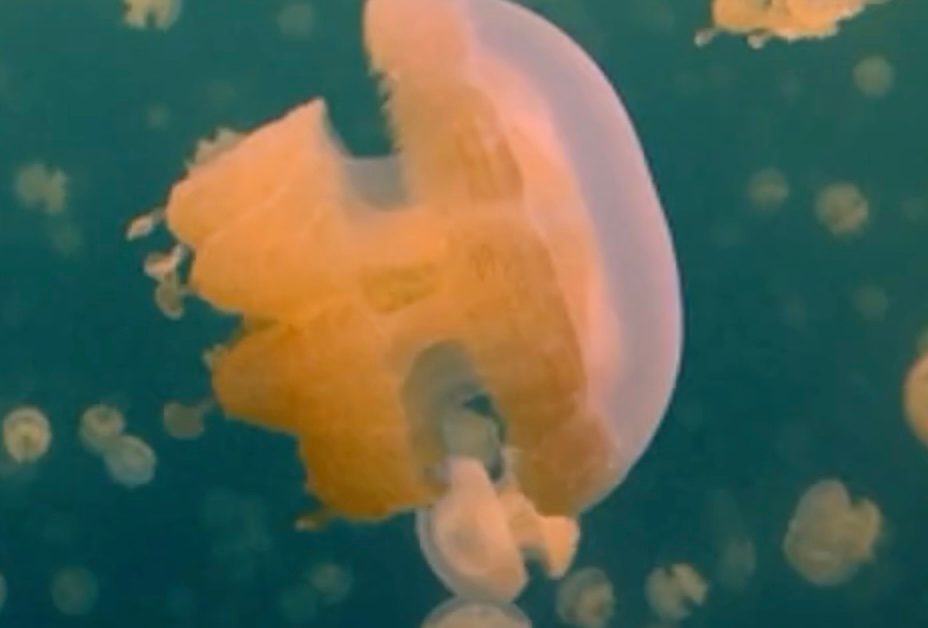
Wildlife spectacles that dominate both streaming platforms and column inches inevitably tend to come from the ‘fur and feather brigades’.
However, some biological phenomena from the ‘less sexy’ taxonomic groups can be just as enthralling, with Palau’s golden jellyfish the supreme example.
Where is Palau?
Consisting of more than 250 islands in the Micronesian subregion of the Pacific Ocean, Palau is the 16th-smallest country in the world. A significant proportion of its economy relies on tourism, especially diving, with its barrier reefs, coral walls, World War II wrecks and celebrated Jellyfish Lake the most important attractions.
Where is Jellyfish Lake?
The 6ha lake lies on the small island of Mecherchar, a 20-minute trek through forest from the shoreline. It is home to millions of jellyfish, the vast majority of which are golden jellyfish. Though the lake appears cut off from the surrounding sea, the calcareous nature of the island’s bedrock means it is in fact connected by a series of underground fissures and cracks to the nearby lagoon. Seawater filters in at high tide, linking the lake with the marine ecosystem.
Read more
What’s so special about Jellyfish Lake?
The lake, which is no more than 30m deep, is classified as ‘meromictic’, meaning it has distinct layers of water that do not mix. The top 13m, to which the golden jellyfish are confined by day, is penetrated by sunshine and suffused with oxygen, resulting in good clarity. Below this is a 2m ‘pink layer’ dominated by bacteria. The zone below spans from a depth of 15m down to the lake’s bottom and is devoid of both light and oxygen. Here, the noxious gas hydrogen sulphide is the commanding force.
Where did golden jellyfish come from?
Golden jellies are believed to have been present ever since a sudden and temporary sea rise filled the lake around 12,000 years ago. In isolation, the jellyfish evolved into a subspecies with vastly reduced appendages compared to its lagoon ancestors. It also lost most of its stinging cells, due to lower predation rates in the lake.
What do golden jellyfish eat?
The golden jellyfish can capture zooplankton, but obtains most of its nutrition from algae in its tissues. In return for accommodation and transport, the algae supply their hosts with photosynthesised sugars. The jellyfish undertake a daily migration to ensure that the algae are able to harvest as much light as possible.
As the sun rises, they move east until they reach the shadow formed by the rocks and trees along the lake shore. Always keen to remain in the sunlight-bathed water, they then return westwards as the sun passes overhead, once again stopping at the shadow. During the course of the day, the jellies constantly rotate in an anticlockwise direction to ensure that their all-important algae receive constant and even sun coverage. At night, the jellies repeatedly drop down to deeper water, presumably to acquire nitrogen and other trace chemicals needed by the algae.
Can you visit Jellyfish Lake?
Due to the high levels of toxic hydrogen sulphide in the lake’s lower reaches, scuba diving is not permitted in Jellyfish Lake, but snorkelling is encouraged. As with most wildlife spectacles, timing is of the essence, and if you can arrive in the morning when the jellies are on the move, then a huge wall of jellyfish should be heading straight for you. Swimming among these pulsating and rotating creatures should be a memorable, pleasurable and pain-free experience, and help to convince you – even if just for a day – why jellyfish deserve to be raised to the pedestal normally occupied by our more vaunted faunal classes.
Read more
How do golden jellyfish reproduce?
The jellyfish’s life-cycle takes on two life-forms: the polyp stage and the medusal (adult) stage. Tiny polyps attach to firm surfaces along the lakeside, and in addition to budding, they produce medusae, which mature into adults. These medusae reproduce sexually by spawning to produce planulae, which transform into polyps.
Are golden jellyfish venomous?
The golden jellyfish has such a mild sting that you can swim safely among a swarm, as it’s evolved without significant predators for some 12,000 years.
More amazing wildlife stories from around the world
Main image: still from a Getty video
