


The Pacific Australia Labour Mobility (PALM) visa is one of very few of Australia’s temporary work visas — and by far the biggest — that mandates family separation. Long-time PALM analyst Peter Mares has written that: “Prolonged family separation is unconscionable.” This is almost right. It is unconscionable if it is enforced by government. It should be for families themselves to decide whether to stay together or not.
PALM workers are of two types: those with short-stay visas, here for several months, mainly to pick fruit; and those with long-stay visas, here for up to four years, mainly to work in abattoirs. It was never going to be practical for short-stay PALM workers to bring their families, so the focus for those who, like myself, have opposed enforced family separation, has always been on the long-stay workers, who make up about half of the total number of PALM workers (currently about 33,000).
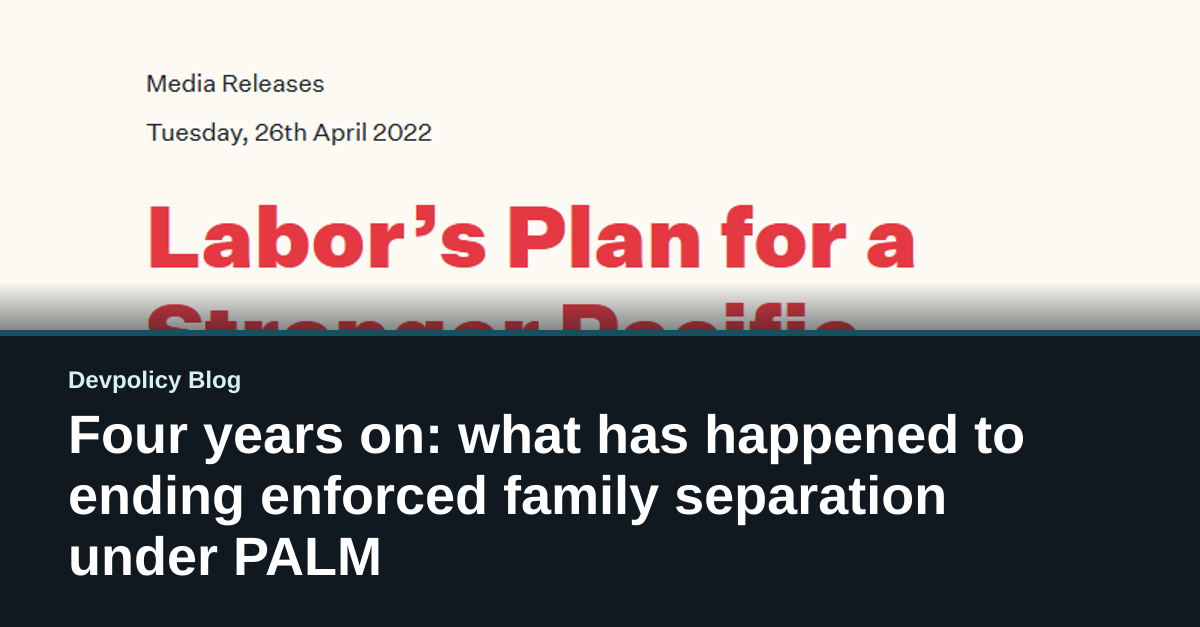
The Labor government promised to end enforced family separation for long-stay PALM workers in its 2022 election campaign. A joint announcement (shown above) by Anthony Albanese, then Opposition leader, with Penny Wong and Pat Conroy among others on 26 April 2022 undertook to allow long-term PALM participants “to bring family members to live and work in Australia”. (The commitment actually referred to Pacific Labour Scheme (PLS) workers. PLS became the long-stay PALM stream in that same month.)
That was in April 2022, more than four years ago. After winning the election, the government first moved to make legislative changes. The Social Services and Other Legislation Amendment (Australia’s Engagement in the Pacific) Act 2023 made long-term PALM workers and their families eligible for the childcare subsidy and the family tax benefit. Medicare access for families in the pilot was also provided through a ministerial order under the health insurance legislation.
At some point the government decided it needed to pilot family accompaniment, and it commenced a pilot in 2024.
The family accompaniment pilot allowed up to 200 PALM long-term workers (from five countries: Fiji, Kiribati, Timor-Leste, Tonga and Vanuatu) to bring their families to Australia if the PALM workers’ employers agreed. As of July 2025, 145 families had arrived. A mid-term evaluation from the pilot released in 2025 found that it was “progressing well” and that families were reporting a “positive experience” in Australia.
The pilot is planned to run to 2027, and presumably a decision will be made after that. That means a decision to allow family accompaniment, if it is made at all, will come five years or more after the election in the run-up to which it was promised, and perhaps only two elections later. (The next federal election is due by May 2028.)
Why is the government taking so long to fulfil its 2022 promise? Even if it became convinced that a pilot was required, it is hard to see why it needed to run to 2027. The mid-term evaluation says that the final report will “include findings relating to demobilisation [and] reintegration of families”. We already know from the mid-term evaluation that some families had not brought their children with them. Some will view this as a negative, but a sounder view is that parents are best placed to make decisions concerning their children.
One reason for the long delay in following through on this 2022 commitment is that the leading PALM controversy continues to concern worker exploitation. Many campaign on this; there is no campaigning to end mandated family separation.
Another reason is that the pilot is gold-plated, with Family Liaison Officers (FLOs) employed to help arriving families. This might not be considered affordable if mainstreamed. The obvious answer here is that FLOs are not needed. Pacific workers and accompanying families will need to look after themselves. We must avoid Pacific paternalism.
Sending-country governments seem supportive of the end to family separation. The three biggest PALM-sending countries are all participating in the pilot. Vanuatu actually included in its 2024 labour mobility policy a bar on participating in the long-stay PALM to avoid family separation, though it is unclear if that is being implemented.
Employers are divided, but about two-thirds of long-stay PALM workers are employed in the meat-processing sector and its peak body is supportive. In any case, employers should not be able to exercise a veto on this matter (though they could advise governments whether, in particularly remote locations, it is feasible to bring a family).
One problem with the current “go slow” approach is that, as the saying goes, justice delayed is justice denied. Right now, most long-term PALM workers are still being denied the right not to be forcibly separated from their family as a result of an employment decision.
Another risk is that the original promise to end enforced family separation may simply be forgotten. A recent Sydney Morning Herald article about the impact of the PALM scheme on children mentioned the 200-worker pilot but not the government commitment to end enforced family separation. There is a risk that in 2027 the current pilot will simply be extended or only marginally expanded.
My view is that Labor made an election promise in 2022. It has made the legislative changes it thinks were needed. It has run a successful pilot. Now is the time for following through and actually implementing what it promised more than four years ago.
If the government is not willing to do this, then a next step that could be implemented immediately would be to allow all long-stay PALM workers employed by companies and from countries willing to allow them to bring their families to do so.
Some countries in Asia and the Middle East prevent migrants on temporary work visas from bringing their families with them. Australia does not, except for (as per the note below) a few exceptions of which PALM is the most important. It is well past time to end the unconscionable and stop enforcing family separation for long-stay PALM workers.
Note: As far as I am aware, Australia’s only other work visa that enforces family separation is the one allowing diplomats to bring domestic workers with them. The numbers involved must be tiny. Family separation is also enforced under backpacker visas, but though these have been described (including by me) as de facto work visas, they are not, unlike PALM, de jure work visas. That’s an important distinction. A backpacker can come to Australia and not work at all. Moreover, the upper age limit on backpacker visas is 30 or 35 so the visa is targeted at young adults . (The Australian government website still says that the working holiday visa “allows young adults to have a 12-month holiday, during which they can undertake short-term work and study”.) Interestingly, students (who also have limited work rights) are allowed to bring their families. Worryingly, One Nation’s new migration policy includes a ban on family accompaniment for both students and temporary skilled workers.
