


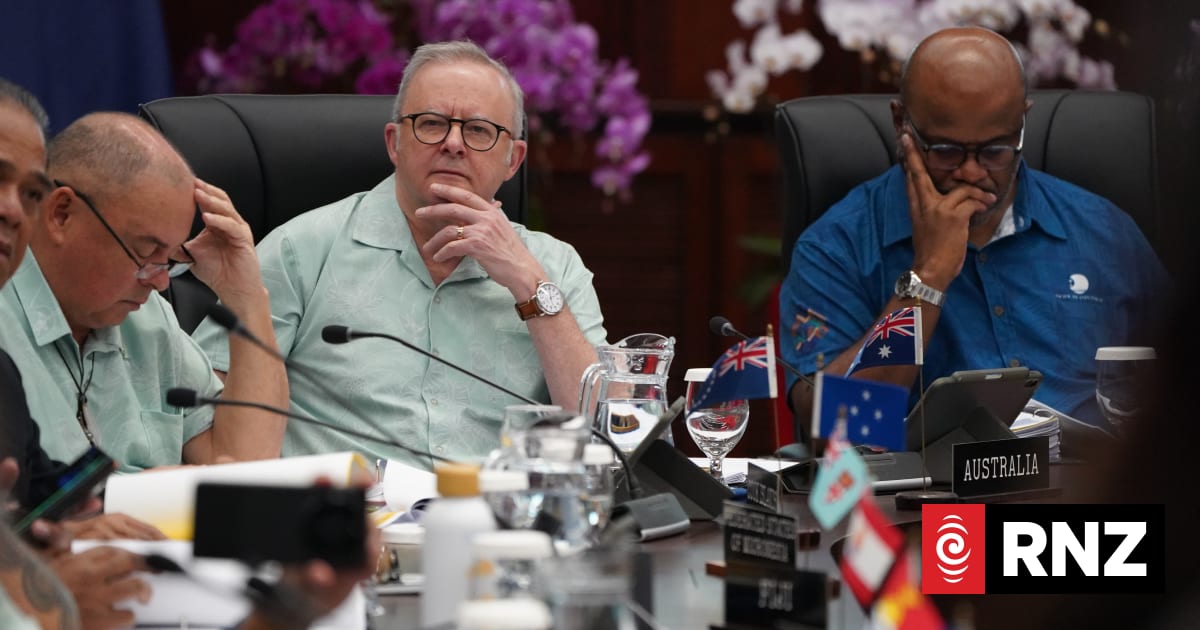
Analysis – On the second day of the Pacific Islands Forum leaders’ meeting in Palau, Australian Prime Minister Anthony Albanese was asked about the potential participation of Torres Strait Islanders in the Melanesian Spearhead Group (MSG) – one of the forum’s three sub-regional groups.
Albanese, alongside his ministers Chris Bowen and Pat Conroy, was holding a press conference at the leaders’ meeting venue in Koror. Bowen holds the climate portfolio while Conroy is Australia’s minister for Pacific Island affairs.
Conroy responded on behalf of his prime minister.
“I was honoured to be the first Australian minister to attend a Melanesian Spearhead Group as an observer in Fiji [in June 2025],” Conroy began.
“Obviously, there’s a process that is going through where the Melanesian Spearhead Group consider whether Australia would be an observer at the MSG. We’re obviously keen to make that happen because we see value in having the people of Australia as an observer through the Australian government at the Melanesian Spearhead Group.”
No mention of the people of Torres Strait Island was made, even after the reporter attempted a follow-up question.
The MSG, which as a starting point acknowledges Torres Strait Islanders as part of its Melanesian family, holds a different view.
The group’s newly appointed director general Anna Naupa, speaking to reporters the previous day, said the MSG’s preference was for Australia to include its Melanesian communities, like Torres Strait Islanders, when engaging with it.
“Because of our attention to our Indigenous Melanesian peoples, very much that is the preference, is that we bring and we connect our communities with each other,” Naupa said.
It is a difference in outlook that reflects some of the wider challenges to Australia’s engagement in the Pacific region.
Sometimes the subtleties and nuances of regional politics can be lost or completely dismissed by the Australians.
Flag display during the Smaller Island States Leaders Meeting. 31 August 2026.
TMC Palau/Ohanna Rabo Galo
Climate contradictions
Other times it feels like Australia does not fully appreciate – outwardly at least – how closely watched it is by smaller Pacific nations.
For example, one of the major developments at the leaders’ meeting was the release of a report from the UN Environment Programme, which stated that overshooting the Paris Climate Accord goal of 1.5C was now unavoidable.
It came a day after Albanese’s government supported the opening of a new fracking project in the Northern Territory.
It was also confirmed during the week that Albanese’s government had approved the expansion of an open-cut coal mine in Queensland.
Vanuatu’s Climate Minister Ralph Regenvanu, fresh from a climate media briefing on the UN report release, pointed the finger squarely at the Forum’s largest member in Koror.
“Australia is a great partner for the Pacific in helping adaptation and renewable energy pathways, and that’s all good,” he said.
“But as I said … in the press conference, fossil fuels remain the primary driver [of rising temperatures]. And if you expand fossil fuels, you’re not recognising the declaration you signed up to yourself, which is Boe, which says it’s the greatest single threat to the peoples of the Pacific.
“So that is a contradiction that Australia needs to find a way out of,” Regenvanu said.
Similar to previous years, climate change featured heavily in the leaders’ meeting communique this year.
Leaders signed off on the Belau declaration for urgent and inclusive climate action to keep 1.5C within reach through it. As part of that, the Boe Declaration was recalled.
Leaders also reaffirmed that “climate change remains the single greatest threat to the security, livelihoods, wellbeing and future of the peoples of the Pacific”.
For his part, Albanese did not miss a beat when questioned about whether his government’s commitment to the climate crisis was geniune.
“We all need to do more,” he told reporters.
He also made the point that Pacific leaders understood Australia’s current reliance on fossil fuels and “have respect for the position that we’ve taken” – directly contradicting Regenvanu’s words.
“They also understand with the transition [away from fossil fuels] – because they’re dealing with it as well – that the transition can’t happen overnight, that it requires strategies and policies to be put in place,” Albanese said.
It’s not new for countries in the Pacific to have different outlooks – but when it comes to these regional big issues, there’s a gap between the Australian view and those of the Pacific islands that may suggest a lack of understanding of the latter by the former.
Security arrangements
In regard to traditional security, Australia’s been building an array of treaties and bilateral agreements with different partners across the region over several years and particularly in recent months.
These include the Ocean of Peace Alliance or Veitacini Treaty with Fiji, which other parties may eventually join, the Nakamal agreement with Vanuatu, the Pukpuk treaty with Papua New Guinea, the Nauru-Australia Treaty and the Falepili Union with Tuvalu.
Despite that, it will likely have come away from this year’s forum feeling slightly short-changed because there were signs of a handbrake being applied on this security stuff, amid concerns from Pacific islanders about where it’s all heading, and how quickly it’s going that way.
As part of the Forum’s peace and security agenda, the Joint Heads of Pacific Security (JHOPS) which is headquartered at Australia’s Department of Defence, has been tabled under the review of the regional architecture.
The JHOPS brings together the heads of police, military, customs and immigration agencies from across the region. Japan and the US are observers.
Civil society group Pacific Action Network on Globalisation (PANG) has raised serious concerns about the insertion of JHOPS and a regional deployment framework into the forum-led security architecture.
Its main concern is the lack of scrutiny over the process, and the potential legal structures that may result which lock Pacific nations into security arrangements they hadn’t foreseen or agreed to.
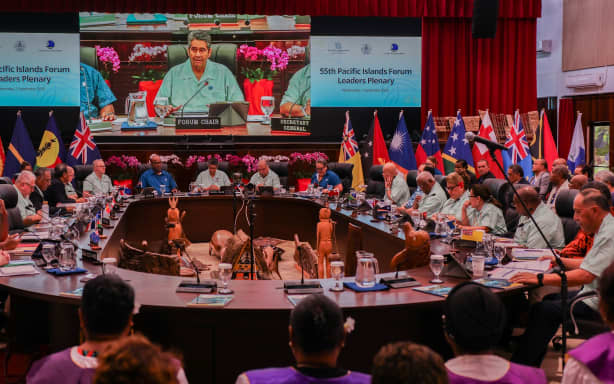
Leaders at the round table for the 55th Pacific Islands Forum Leaders Meeting Plenary in Koror, Palau. 2 September 2026.
TMC Palau/Ohanna Rabo Galo
In Koror, PANG along with the Pacific Regional NGO Organisations Alliance was represented by Joey Tau.
He told RNZ Pacific he was pleased leaders had only agreed in principle to recognise JHOPS as part of the Forum-led security architecture, noting in the communique that further consultation would be needed.
Similarly, the Waqa Moana maritime security initiative targeting illicit drug trafficking, backed heavily by Australia, was only agreed to in principle by leaders, with the overall decision seeking more consultation.
To add to that, the proposal from the Solomon Islands for a regional security treaty, which Australia’s said it is open to, has been kicked down the road. Leaders chose to note the proposal and acknowledged further consultation among members.
Overall, as Tau, pointed out, there are still major questions over the direction of the reform of the forum’s regional architecture, and the processes and people guiding it.
“We’re in a state where, not only external parties, but member states who are part of the whole architecture are driving security agreements, compacts, initiatives, without proper consultation,” he said.
For Australia, which has steadily increased its activity and engagement in the region, particularly aroud security, it may be questioning where exactly the speedbumps emerged at last week’s Forum leaders’ summit.
The resourcing it brings will always afford it a seat at the table, and there’s no doubt its investment in the Pacific in areas such as sport, particularly rugby league has gone down well.
But understanding how to discuss contentious issues and negotiate in Pacific circles are not skills that come automatically with ‘big ticket’ agreements and promises – they are honed through relationships, experience and being in the room.
Time in the region will also let you know that more often than not, decisions turn on a dime, as the absence of several leaders from the forum showed last week. It’s all part and parcel of politics in the Pacific region.
