


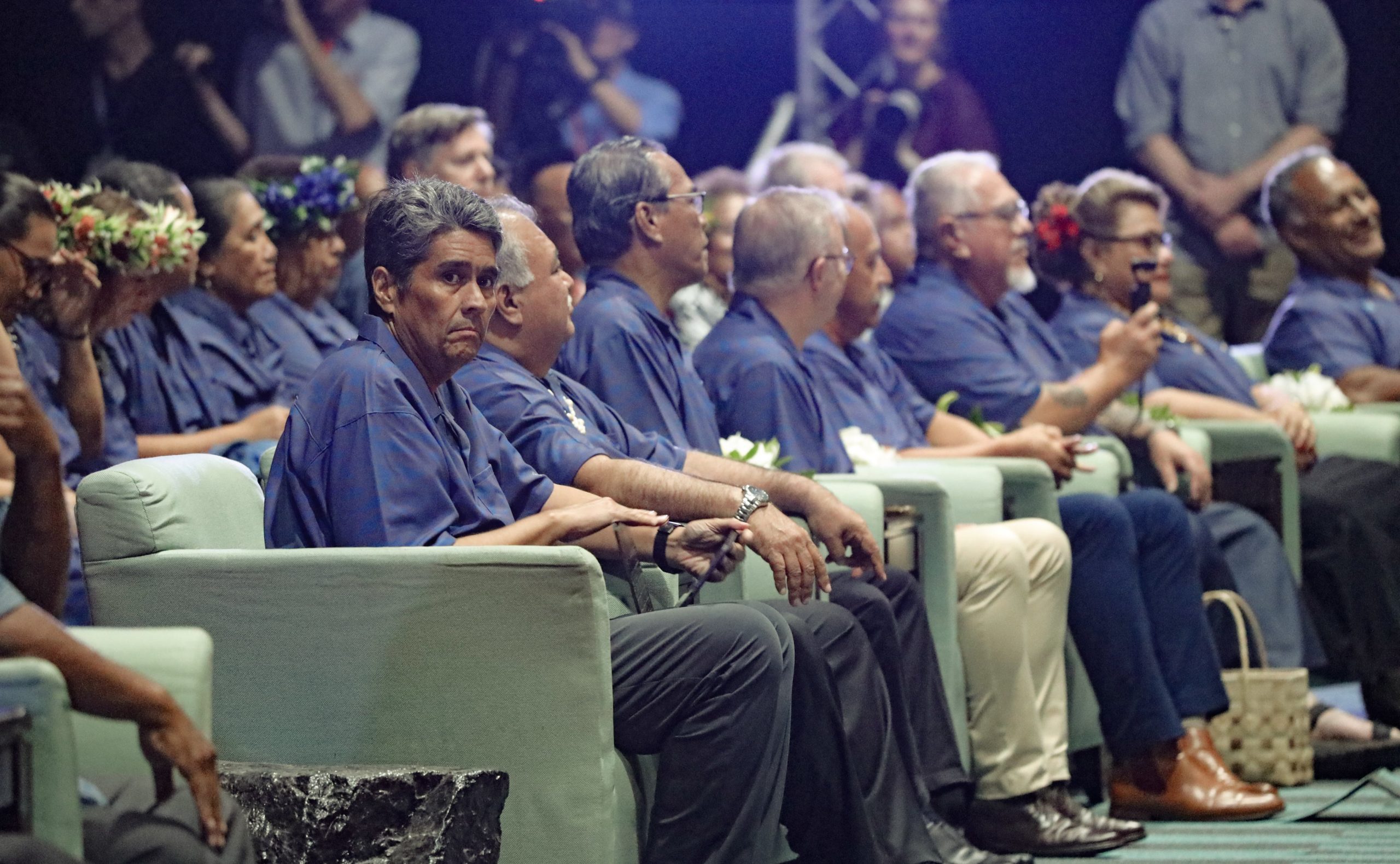
AS delegations head home from the 55th Pacific Islands Forum in Koror, capital of the Republic of Palau, the region’s presidents, prime ministers and officials have endorsed a series of declarations and resolutions in their final communique.
Forum host and incoming chair, President of Palau Surangel Whipps Jr. said: “Over the week-long deliberations, we have reflected deeply on shared priorities. We affirmed our regional unity and agreed on clear actions to guide the Blue Pacific continent through an increasingly complex and challenging strategic environment…we acknowledge that we are in a very uncertain times with many competing priorities and contestation around us.”
The summit agenda was overcrowded and bracketed by an extensive array of side-events, as crowds of dialogue partners, civil society groups and observers organised dozens of discussion panels and briefings. Despite the absence of six of the 18 elected leaders, country delegations grappled with the economic and energy implications of the US and Israel war on Iran and the challenge of finding sufficient resources to implement Forum development priorities.
The week’s discussions came at a time of increasing strategic tensions between the United States and People’s Republic of China, amplified by Canberra’s “permanent competition” with Beijing and sharpening criticism of China by New Zealand. Throughout the week, much of the international media coverage highlighted debates about Taiwan, Chinese missile testing and US security agendas, often overshadowing Blue Pacific agendas on climate, oceans and human security.
The Forum communique contains the full details of the leaders’ decisions, but here are some highlights on climate and oceans, nuclear challenges, the evolving reginal security architecture, and the challenge of engaging with an increasing number of partners.
Climate and oceans
Forum leaders issued a series of statements on climate action and the climate / oceans nexus, as members prepare for the opening of the UN General Assembly in September, October’s pre-COP in Fiji and Tuvalu and then global climate negotiations at COP31 in Antalya, Türkiye.
The “Palau Declaration for urgent and inclusive climate action to keep 1.5 within reach” sets out the region’s climate agenda for the coming months, stressing “the urgency of ambitious global action consistent with the best available science”. President Whipps noted that leaders also endorsed a Pacific Gender Climate Act “which represents our holistic commitment to gender responsive climate action.”
Ad Forum chair, Whipps said that “we recognise that disasters continue to beset our region and the Pacific Humanitarian Response Coordination Mechanism operating guidelines we endorsed this week will give effect to a more structured regional response in times of humanitarian crisis.”
Australian Prime Minister Anthony Albanese, Climate Minister Chris Bowen and Pacific Affairs Minister Pat Conroy were active during the week, as Bowen prepares to assume the COP31 co-presidency in Türkiye and Canberra promotes a strategy for the transition to renewable energy in Forum island countries.
However, many Pacific governments and civil society groups continued to press for faster, urgent action to end fossil fuel exploration, exploitation and exports, often angered by the climate hypocrisy of the largest Forum members.
On the very day of the Forum Leaders Ascent Dialogue on Climate Change, NZ Foreign Minister Winston Peters tweeted that if he’s in the next NZ government after looming national elections, “NZFirst will pull out of the Paris Agreement.” With the United States already abandoning climate commitments, New Zealand’s backsliding will be high on the agenda when they host the 56th Forum summit in 2027.
Environment groups also condemned the Albanese Labor government’s approval of BHP’s Saraji Mine Grevillea Pit Continuation Project, extending the life of one of Australia’s largest coal mines to allow mining to continue for another 30 years. Greenpeace reported that the BHP project “will be the 10th fossil fuel project approved during this term of government and the 37th new fossil fuel project approved since the Albanese government was elected in 2022.”
As the Forum debated a common climate agenda for the next few months, the United Nations Environment Program issued a report of the risks of overshooting the target of 1.5 degrees C above pre-industrial temperatures. In response, Pacific climate ministers pointedly criticised the ongoing expansion of fossil fuel projects by OECD countries and other major emitters.
Asked about Australia’s ongoing approval of new oil, gas and coal projects, Vanuatu Climate Minister Ralph Regenvanu said: “Australia is not doing enough. Australia is a major producer of fossil fuels we all know. Fossil fuels are the primary driver of the climate crisis. So, the very least a country like Australia should do is stopping future expansion – and it’s not doing that. You need to stop expansion, and you need to start transitioning away.”
Despite this, the week also featured Forum co-ordination on Pacific climate diplomacy. Leaders acknowledged last May’s United Nations General Assembly resolution welcoming the unanimous ICJ Advisory Opinion on state obligations on climate change, affirming “its importance as an authoritative contribution to the clarification of existing international law.”
They also welcomed the entry into force of the Agreement to establish the Pacific Resilience Facility (PRF) last May, as 14 of 15 signatories have ratified the treaty. Describing the PRF as “the region’s pre-eminent climate finance investment priority”, President Whipps welcomed new pledges to the new climate resilience fund: “I’m very proud to announce a very strong support for the PRF at this meeting. In total, we have secured an additional $USD20.5 million in pledges this week. We are also committed to advance our fundraising efforts which will be led by the Troika [Solomon Islands, Palau and New Zealand], Tonga and Papua New Guinea.”
As the PRF commences a pilot program for small grants across nine Forum countries, new pledges came from Norway ($USD1.05m), Palau (via GCF readiness), Papua New Guinea ($USD4.5 million), Republic of Marshall Islands ($USD1 million), and the United Kingdom ($USD14 million).
Leaders also issued the 2026 Pacific Islands Forum Leaders’ Ocean Statement to frame the region’s advocacy and action on Pacific Ocean priorities on BBNJ, maritime boundaries and the contested topic of deep sea mining. They endorsed another three-year term for Dr Filimon Manoni of the Republic of Marshall Islands as the Pacific Oceans Commissioner.
Nuclear agenda
As reported by Islands Business, Forum leaders have been grappling with an appropriate response to the July 6 Chinese test of a submarine launched ballistic missile into Pacific waters. Some members were reluctant for a joint Forum statement to condemn China alone, while ANZUS allies Australia and New Zealand will not support public condemnation of the more extensive and regular US missile testing program, just one aspect of Washington’s current militarisation of the northern Pacific.
In Palau, leaders adopted a compromise that condemned China without using the word “China.”
Recalling the Blue Pacific Ocean of Peace Declaration, leaders “registered concern on the recent intercontinental ballistic missile (ICBM) test which overflew a number of members without adequate notice. Leaders called on all States undertaking ICBM testing to ensure transparency and reassurance including through the provision of advance notification of at least 24 hours in accordance with international practice. Leaders emphasised the importance of all States conducting ICBM tests to do so consistently with the Blue Pacific Ocean of Peace Declaration, Treaty of Rarotonga and in respect of the sovereignty of Forum Members.” (A footnote to the statement notes that “the Republic of Naoero disassociates itself with this paragraph.”)
The problem with this classic Forum fudge is that it fixates on the issue of adequate notification, rather than the way that China, the United States and other nuclear powers are modernising their nuclear arsenals and the platforms that will deliver new warheads, with increasing deployments in the region.
The missile testing statement sits uneasily with other statements in the final communique, which reaffirm “the Pacific’s longstanding commitment to a peaceful and secure nuclear-free region, in particular one that is free of nuclear weapons and nuclear testing.” In other sections, the communique expresses “deep concern at rising global nuclear risks, including expanding nuclear arsenals, increasing tensions among nuclear-armed states, and the erosion of international disarmament and arms control frameworks” and also expresses “their grave concern about growing nuclear weapons stockpiles and called on all states to advance the shared goal of a world free of nuclear weapons.”
Alongside the criticism of the latest Chinese missile test, the outcomes statement also address a number of outstanding nuclear issues – from Japan’s dumping of treated Fukushima wastewater into the Pacific to the lack of a “substantive outcome” at the 11th NPT Review Conference and the US refusal to address long-standing Marshallese calls to address the consequences of 67 US nuclear tests at Bikini and Enewetak Atolls.
The communique praises the Kingdom of Tonga on its accession to the Treaty on the Prohibition of Nuclear Weapons (TPNW) and ratification of the Comprehensive Nuclear-Test-Ban Treaty (CTBT), completing universalisation of the CTBT in the Pacific (the TPNW nuclear test ban has been ratified by 11 Forum members, leaving Australia, Papua New Guinea, Marshall Islands and Federated States of Micronesia).
To advance the nuclear agenda, the Forum will hold the second Meeting of States Parties to the Treaty of Rarotonga for a South Pacific Nuclear Free Zone (SPNFZ) in December 2026, alongside events to commemorate the 40th anniversary of the Treaty’s entry into force.
New security architecture
While leaders “reaffirmed the expanded concept of security and that climate change remains the single greatest threat to the livelihoods, security and wellbeing of Pacific people and communities”, the summit made a series of decisions that focused on traditional state to state security and transnational threats.
In the absence of Solomon Islands Prime Minister Matthew Wale—who arrived in Koror but turned around within hours to resist a parliamentary no-confidence motion at home—his proposal for establishment of a “Blue Pacific Ocean of Peace Regional Security Treaty” was noted but quietly punted off to members for further consultations and discussion.
The Forum chair noted the region-wide concern over “transnational crime and its impact on our societies and we have begun the work of resolving this collectively through initiatives such as the Waqa Moana concept,” backed by an $AUD600 million Australian funding package.
As they endorsed a new Regional Peace and Security Action Plan 2026–—2030, leaders agreed in principle to the inclusion of the Pacific Police Ministers Meeting within the Forum architecture. They also backed recognition of the Joint Heads of Pacific Security (JHoPS) meeting within the regional peace and security architecture (although acknowledging the need for further consultation, amid civil society concern that non-state actors are being sidelined in new policing and security structures in the region).
As the growing AI bubble around the world transforms industry, media and culture, it is raising concern over the environmental and economic impacts of massive data centres, and cyber-security concerns. For the first time, the Forum has adopted Pacific Digital and Artificial Intelligence Technology Principles, to inform the development of the region’s first AI governance framework.
The Forum communique did not include much detail, but there was significant discussion on issues of self-determination and decolonisation, with a caucus of Melanesian Spearhead Group members issuing a detailed statement on New Caledonia and West Papua. As New Caledonia’s FLNKS President Christian Tein and West Papuan independence leaders Benny Wenda and Octo Mote observed the Forum plenary, civil society groups called for further action on decolonisation in New Caledonia.
The new MSG Director General Dr. Anna Naupa told Islands Business that a planned fact-finding mission to Indonesia remained on the agenda. The PIF Secretariat will work with the MSG Secretariat and Indonesia to facilitate the mission, particularly while Jakarta holds the presidency of the UN Human Rights Council (full report on in next month’s Islands Business magazine).
During the week, Vanuatu also announced it had lodged an application to the International Court of Justice, seeking recognition of its sovereignty over Umaenupne (Matthew) and Umaeneag (Hunter), amidst the long-running dispute with France over the maritime boundary between Vanuatu and the neighbouring French colony of New Caledonia.
Engaging with partners
Throughout the week, the annual propaganda war between Taiwan and the People’s Republic of China was in full force and dominated international media coverage, with host nation Palau welcoming the Taiwanese Foreign Minister to sideline meetings during the week – the anger of China’s Special Envoy Qian Bo.
Despite all the fire and fury, the status quo was reaffirmed, with Taiwan remaining as a Forum “development partner” to meet its three remaining diplomatic partners on the sidelines of the annual summit. The Taiwanese government is not eligible to be considered in the new Leaders Policy on Partnerships, adopted at last year’s Forum in Honiara – a new framework that will guides relations with the Forum’s 21 Dialogue Partners.
After an extensive review by Forum Secretariat of the role of the dialogue partners, leaders in Palau adopted a two-tiered system and agreed on the placement of partners in two partnership streams, for strategic partners and sectoral partners. Only strategic partners will be eligible to join the Forum dialogue with leaders each year, while others sectoral partners will operate at ministerial level.
Forum Secretary General Baron Waqa has been tasked with telling partners who makes the cut in the premier league, which will involve longstanding players in the region (United States, France, China, European Union, Japan and Canada) but also newly emerging strategic partners like Korea, India, Indonesia and United Arab Emirates. The Forum will also conduct a “periodic review informed by an accountability and reporting” be implemented from 2027 (presumably to deal with partners who think they should be upgraded).
The final Forum communique notes that the 2059 Blue Pacific Strategy “rests on partnerships that are genuine, durable, and accountable, and which strengthen Pacific leadership, voice, and engagement to ensure recognition and alignment with Pacific cultures, values, priorities, and collective interests.”
Fine words indeed, but not matched by the practice of most partners, who talk the talk on respect for Pacific leadership but rarely walk the walk, as they drive their own agendas!
The debate about partner engagement will play out in coming years, as Forum leaders announce the next sequence of annual summits: New Zealand (2027); Naoero (2028 to coincide with its 60th independence anniversary); Marshall Islands (2029); Vanuatu (2030, to coincide with its 50th independence anniversary); and French Polynesia (2031).
The next edition of Islands Business magazine in September will include further reports on the Forum outcomes. Subscribe today!
