


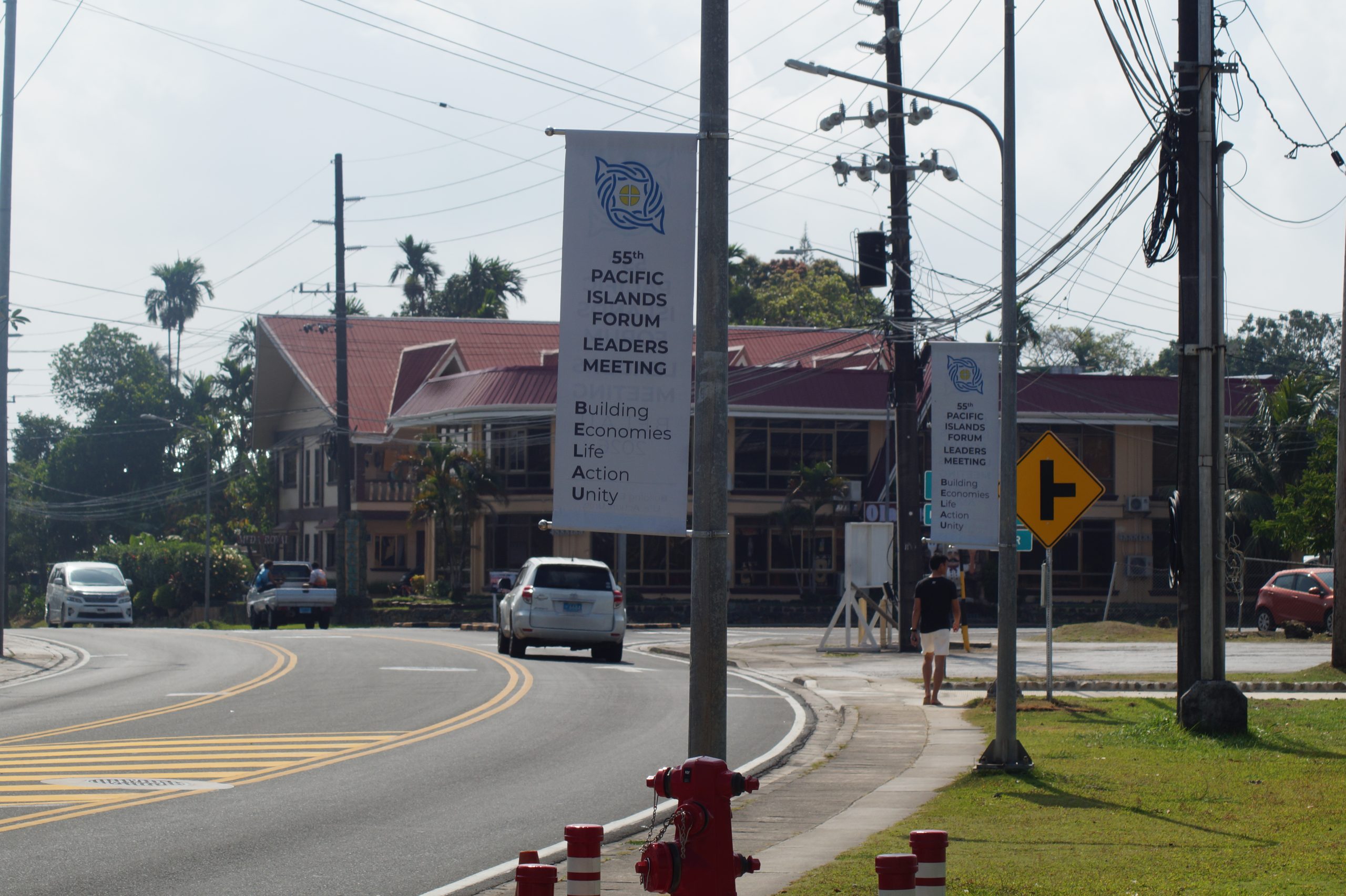
Analysis: In recent years, the members of the Pacific Islands Forum have clung to the idea of the organisation’s centrality as a barrier to outsiders trying to divide and conquer them.
Whether the United States, China, or any other nation seeking to build influence in the Pacific, the message from the forum and most of its members (New Zealand included) has been clear – go through the proper channels if you want to be successful.
But as leaders prepare for the official launch of the forum on Monday evening, the strength of those channels has come into question as more nations find themselves unable or unwilling to send top-level representation.
Less than a day after arriving in Palau, Solomon Islands Prime Minister Matthew Wale headed back home after a minister in his government lodged a motion of no confidence in his leadership; perhaps Christopher Luxon will be second-guessing his own decision to travel to the forum, having already survived two such votes this year.
Speaking to reporters in Palau, Foreign Minister Winston Peters said the departure of the Solomons leader – who was seen off at the airport by Palau president Surangel Whipps himself – was understandable, as was the absence of others because of ill health. Samoan’s Laʻauli Leuatea Schmidt and Vanuatu’s Jotham Napat are among those who will not attend, and the plans of Naoero’s (formerly Nauru) leader David Adeang and Fiji’s Sitiveni Rabuka remain unclear.
“In the main the delegations are of the highest standard, so let’s see how we go,” Peters said.
The foreign minister appeared less tolerant of Kiribati president Taneti Maamau’s absence, with the leader citing a lack of available flights and a clash with the country’s parliamentary sitting.
“We’ve all got to organise ourselves around these matters to get here – the centrality of the Pacific Islands Forum is not going to be compromised because of this, but it doesn’t help,” Peters said.
In 2025, the coalition Government launched a review of New Zealand’s aid to Kiribati after Maamau pulled out of a pre-arranged meeting, following what a spokesperson for Peters said had been a “months-long” effort to discuss the bilateral relationship.
At the time, Kiribati opposition leader Tessie Lambourne told Newsroom that Maamau’s snub appeared to be an effort to “demonstrate their loyalty to the partnership with China”, and there have been suggestions a similar dynamic is at play here; Palau is a staunch ally of Taiwan, and the Kiribati president’s replacement at the forum is not a minister but a foreign service director (and former ambassador to China), David Teeabo.
Asked by Newsroom what he made of the country’s representation, Peters responded: “Well, it’s not the Pacific way to rub injury in the sense that you suggest I answer, but it’s a disappointment, and that’s what our position is.”
Was foreign interference to blame, another reporter asked? “Well, you’d be defying gravity and logic if you said it wasn’t a big problem.”
Regardless of the reason, the absence of Maamau – along with several other Pacific leaders – has put the forum on the back foot as it prepares to discuss some very pressing issues facing the region.
The push for a Pacific-wide security pact, as promoted by Wale, seems likely to be put on the backburner in his absence, while other contentious issues may also need to wait until a more thorough consensus can be reached.
Unsurprisingly, Whipps has sought to downplay the significance of the absent leaders, noting a renewed sense of solidarity after the fallout from the contentious selection of Henry Puna as the forum’s secretary general in 2021.
“One of the things that we’ve seen since the little hiccup, or you could say the rift that happened … the Pacific is back together and stronger,” the Palau president told reporters on Sunday.
“Crises come up, but how how do we find a way to make sure that we try to get within everybody’s schedule and we can maximise the amount of leaders for every meeting, because there’s no question when the leaders are assembled, then we can get partners to deliver, and that’s something that’s so important.”
But this year’s no-shows do little to reinforce that, as Massey University associate professor and Pacific expert Anna Powles noted on social media: “The region has long argued its currency is its cohesion and power as a bloc. This is being seriously undermined.”
Peters and others must forge on nonetheless, with the foreign minister promising to ensure that New Zealand’s Pacific partners “realise that we’re here with a serious purpose, not just to fill the seats, but to make sure that as part of the Blue Continent, which is our front yard, we make our contribution”.
Exactly what that contribution looks like should become clearer in the coming days: Peters teased an announcement related to the economic pressure caused by fuel shortages, while also indicating he would continue to press the United States (among others) to step up their efforts in the region.
But exerting such pressure on behalf of the forum requires confidence that its members can speak as one – something that may not be so clear-cut by the week’s end.
