


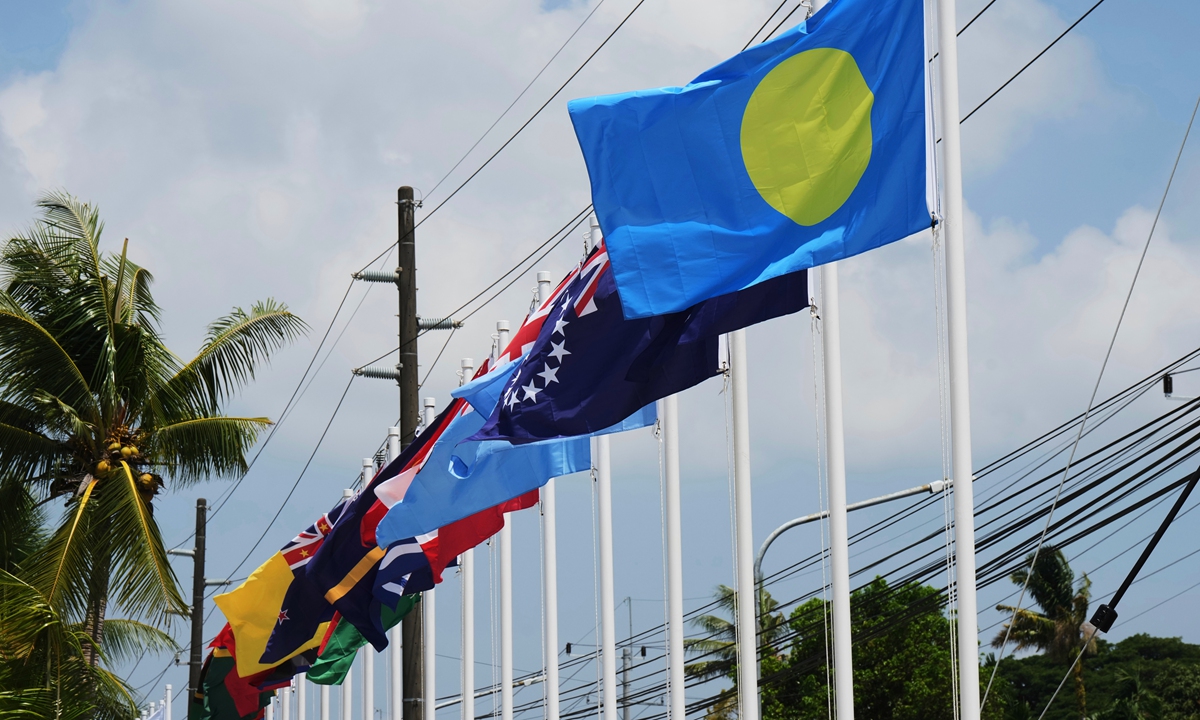
Flags of member states fly outside the summit venue for the Pacific Islands Forum Leaders Meeting in Koror, Palau, on August 30, 2026. Photo: VCG
The 55th Pacific Islands Forum (PIF) Leaders Meeting is being held in Palau, with climate action and finance, food security, transnational crime, and other regional challenges high on the agenda. The meeting comes as Palau’s President Surangel Whipps Jr. has repeatedly hyped China’s missile test in July, while “representatives” from the Taiwan region are also in Palau to attend PIF-related events, putting geopolitical factors under greater scrutiny.
A Chinese expert said the PIF should not be turned into a stage for geopolitical rivalry. Whether the forum truly serves Pacific island countries should be judged not by how tough it sounds toward any major power, but by whether it can help address their core concerns. By providing space for authorities from the Taiwan region to participate in related activities, Palau is using its host status to manipulate the Taiwan question and expand the Taiwan authorities’ political presence through a regional multilateral platform. Attempts to drag the forum into bloc politics would run counter to the real interests of Pacific island countries.
At least five heads of government were absent from the annual Pacific Island Forum, Reuters reported on Monday, including the prime ministers of Fiji, Vanuatu, Samoa and the Solomon Islands and the president of Kiribati.
Following China’s missile test in July, Whipps described it in an interview with RNZ Pacific as “opaque or secretive.” His rhetoric later escalated. In August, he called for a so-called “united front” among Pacific island countries against China, and claimed the test was intended to signal that China could “take out” any of their islands.
Whipps’ persistent hyping of the so-called “China threat” rhetoric reflects his misguided strategic choices. Palau has long positioned itself against the one-China Principle on the Taiwan question, and Whipps has repeatedly exaggerated external threats in an attempt to justify such policies, Chen Hong, director of the Australian Studies Center of East China Normal University, told the Global Times on Monday.
“Whipps is trying to package Palau’s own security dependence and stance toward China as a shared anxiety across the Pacific. In essence, this is not only about fabricating a ‘China threat,’ but also about inflating Palau’s own strategic value through threat narratives to gain greater external attention and Whipps’ own political capital,” Chen said.
According to a Reuters report on August 7, Pacific Island foreign ministers failed to agree on a joint response to China’s missile launch in July.
Chen pointed out that Whipps’ call for a so-called “united front” against China reflects a dangerous bloc mentality. The PIF is neither a military alliance nor a political grouping aimed at containing any country, he said. The lack of a unified position on China within the forum shows that Pacific island countries have different interests and security assessments and are unwilling to be pushed into choosing sides or accepting an artificially created “common enemy.”
Lin Chia-lung, head of Taiwan’s so-called “foreign affairs” authorities, is also attending the related events in Palau.
According to reports from the Pacific News Service Association (PINA), there was no “representatives” from the Taiwan region participating in last year’s Forum in Honiara, where no external partners were present. Leaders at the meeting reconfirmed the status quo on the Taiwan region, which has never been a Forum member nor a Dialogue Partner.
Chinese Foreign Ministry spokesperson Guo Jiakun said on August 11 that on the participation of China’s Taiwan region in the events of international organizations, China’s position is consistent and clear, that is, it must be handled in accordance with the one-China Principle. China urges the Secretariat of PIF to abide by the one-China Principle and properly handle Taiwan-related issues to avoid disrupting the sound and steady development of the relations between China and the PIF.
On August 18, responding to a media inquiry that it’s reported Whipps said he was hoping to achieve a “united front” of Pacific Island countries against China’s recent test launch, Chinese Foreign Ministry spokesperson Lin Jian said that the Chinese side had stated its position on the test launch. The allegations from the Palau side, which is referring to Whipps’ claims that he was hoping to achieve a “united front” of Pacific Island countries against China’s recent test launch, are groundless, ill-intentioned and not worth further commentary.
Chen stressed that the PIF should not allow geopolitical security narratives to overshadow the urgent challenges facing Pacific island countries. The forum should remain focused on the real interests of Pacific island countries rather than become a stage for bloc politics or competition among major powers, the expert said.
