


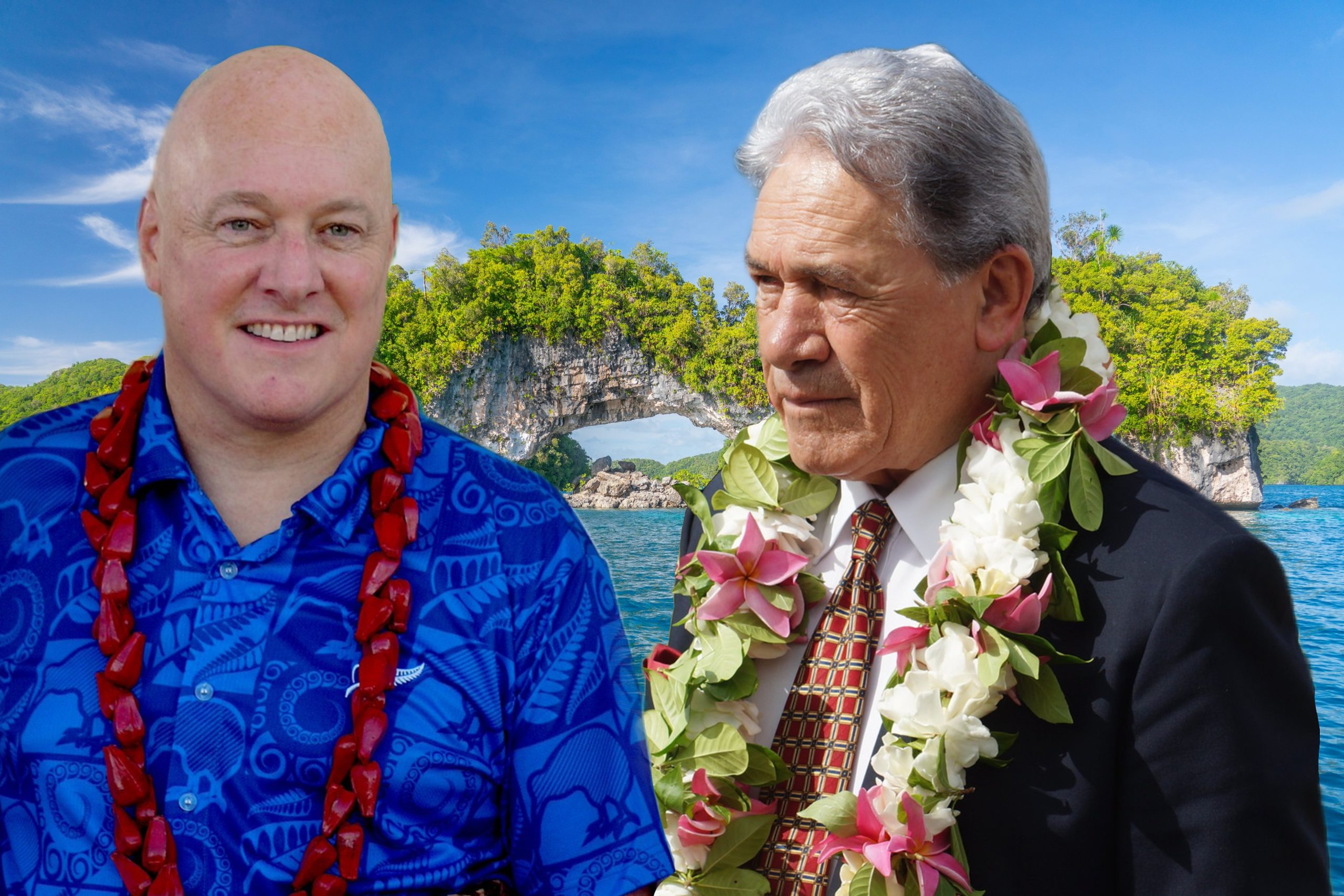
With coalition relations increasingly fractious in the run-in to November 7’s election, a Pacific getaway might seem just the tonic to reinvigorate the relationship between Christopher Luxon and Winston Peters.
Yet while the pair are jet-setting to Palau for the annual meeting of Pacific Islands Forum leaders this week, their schedules won’t allow for any bonding; the Foreign Minister departs the Micronesian nation the evening before the Prime Minister himself arrives, a function of their pressing domestic agendas as much as anything else.
Nor will either have much time for relaxation while on the ground, given the suite of issues facing Pacific leaders in an unstable world.
Dr Anna Powles, a Pacific expert and associate professor at Massey University’s Centre for Defence and Security Studies, says energy security will be high on the agenda, with the ongoing conflict in the Middle East having laid bare the downsides of Pacific nations’ reliance on fossil fuels.
According to the Center for Strategic and International Studies, oil provides roughly 80 percent of the Pacific’s energy – a figure that rises to 98 percent in some countries – with Tuvalu (to name one example) spending roughly a quarter of its GDP on petroleum imports.
In May, forum leaders formally invoked the Biketawa Declaration, a 2000 framework for responding to regional crises, with greater diversity of processing and distribution among the immediate priorities.
“Right now, most of the fuel that comes into the Pacific goes through Fiji as the hub, so there’s a push to develop other fuel hubs across the region as well, and the Solomon Islands is one of those,” Powles says.
The crisis has also further solidified the case for renewable energy investments: a report issued on the eve of the summit by the UNSW Institute for Climate Risk & Response concluded a switch from diesel generation to solar, batteries and new electricity grids could save the Pacific as much as $1.2 billion a year.
Such infrastructure doesn’t come cheap, however, with the region’s economic resilience another issue high up the agenda following the disruption caused by the Iran war – not to mention the Ukraine conflict and the Covid-19 pandemic.
“It’s not just Covid and the energy crisis,” Powles says. “It’s multiple natural disasters … which mean that countries have invariably been stuck in this disaster recovery cycle.”
That explains added anxiety about this year’s record-breaking El Niño weather event, which is already leading to sharp temperature rises and is forecast to get even worse in the coming months.
Cuts in aid spending by traditional aid partners haven’t helped either, and it is unclear whether the likes of the United States have any intention of returning to previous levels of official development assistance.
Ahead of a meeting of the forum’s foreign ministers earlier this month, Peters made clear his desire for Pacific nations to become more economically independent, telling the Pacific Media Network: “It’s unusual. I go to ASEAN [Southeast Asia], and it’s all about the economy, the economy, economy, economy. I go to the Pacific, it’s all about aid.”
But plenty of outsiders are still interested in offering money to the region, and not always for selfless reasons.
Jared Novelly, the new US ambassador to New Zealand, Samoa, the Cook Islands and Niue, has spoken repeatedly about his interest in the Cooks’ mineral-rich seabed, heading to the country last week to learn more, while fellow superpower China continues its efforts to build regional influence.
A Chinese ballistic missile test launched into the Pacific in July divided the forum, with foreign ministers unable to agree on the wording of a response after reported opposition from Kiribati and Naoero (formerly Nauru).
Powles expects a similar impasse when leaders meet, with host Palau’s status as one of just three Pacific states to still hold diplomatic ties with Taiwan (rather than China) adding an extra degree of sensitivity.
Taipei’s presence at this year’s forum itself has already sparked a war of words with Beijing, after Taiwan (along with all non-forum members) was excluded from last year’s meeting in the Solomon Islands.
With forum leaders still trying to determine how non-Pacific nations should be allowed to participate in proceedings, including whether to have ‘tiers’ of membership, there is still a sense that the region is being treated as a chessboard subject to the whims of others.
“There is a strong sense that the region is becoming increasingly securitised and militarised, and that Pacific priorities are not being heeded as a consequence of that, so that frustration and that anxiety – that is still very much at play,” Powles says.
Some leaders are seeking to take matters into their own hands, with Solomon Islands Prime Minister Matthew Wale pitching the idea of a Pacific-wide security pact; any meaningful progress on such an agreement this week seems unlikely, given the need to secure consensus across the region and work through the intricacies of different states’ constitutional ties.
What of New Zealand’s goals at this year’s summit?
While Luxon and Peters may be somewhat distracted by the looming election, Kiwi officials will be watching proceedings even more closely than usual, with New Zealand hosting next year’s meeting of leaders.
That in turn means Luxon (as the incoming forum chair) will become part of the ‘Troika’ alongside its former and current chair, placing the Government in a key position to shape some of the region’s discussions.
“Irrespective of the fact that Prime Minister Luxon may be heading into campaign mode, this does put New Zealand in a very, very important position within the forum architecture … heading into 2027,” Powles says.
Whether Luxon, or Peters, will be at the helm for the forum next year will depend on matters far closer to home.
