


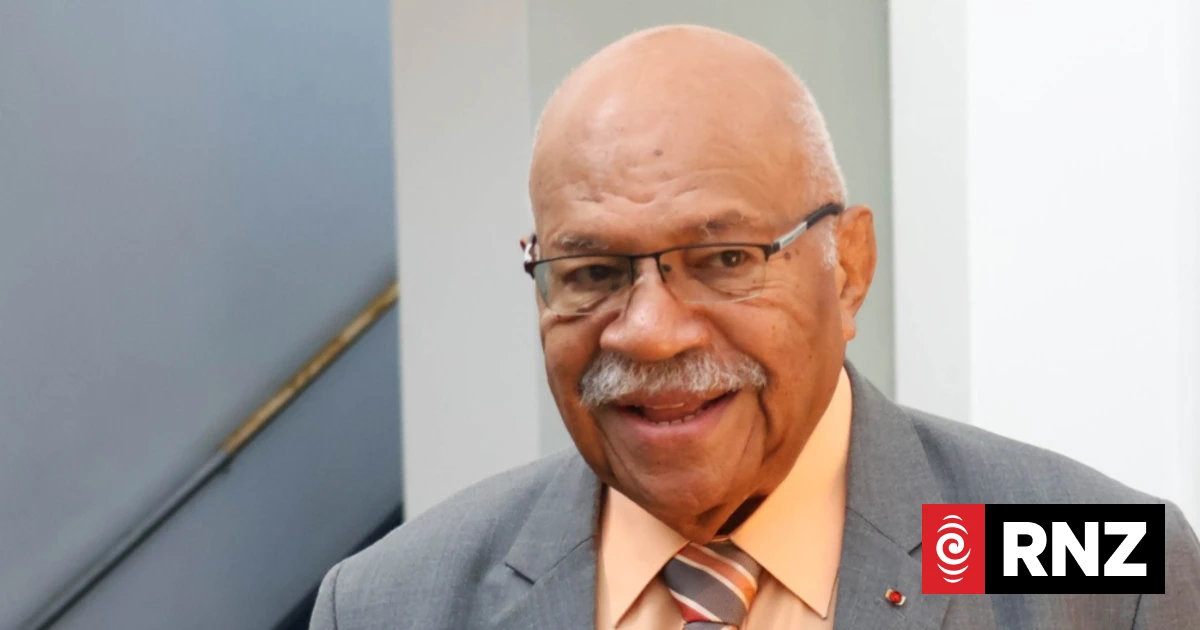
Fijian Prime Minister Sitiveni Rabuka says he will appeal against a High Court decision quashing the report of a Commission of Inquiry (COI) into the appointment of a former head of the country’s anti-corruption agency.
The months-long inquiry, which cost the taxpayer around FJ$2 million (NZ$1.5m), has become a major political issue for Rabuka’s coalition government.
The COI, headed by Australian judge Justice David Ashton-Lewis, began on 31 October 2024 and was originally due to conclude on 31 January 2025, but continued until 1 May 2025.
Acting on the inquiry’s recommendations, Rabuka advised the country’s president that the then-commissioner of the Fiji Independent Commission Against Corruption (FICAC), Barbara Malimali, should be sacked.
Malimali strongly challenged her suspension and subsequent sacking and launched a judicial review against Rabuka and President Ratu Naiqama Lalabalavu.
Fiji’s High Court ruled in February that Malimali’s dismissal was unlawful, a decision immediately appealed by Rabuka.
Then, in June, the High Court rejected Rabuka’s attempt to stall its ruling that Malimali was illegally sacked.
Nearly two years after the inquiry was established, Rabuka faced another legal setback when the High Court ruled last Friday that the inquiry report, in its entirety, was null and void.
The High Court found that the inquiry’s work after 31 January 2025 was unlawful because its term had not been validly extended, and the president lacked the power to extend its term.
“[The] commission’s work from 1 February 2025, and the COI Report dated 1 May 2025, is ultra vires,” the judgement stated.
Ultra vires is a legal term meaning beyond lawful authority.
The ruling comes as political parties prepare for Fiji’s next general election, which is due later this year.
Following the court’s decision, Rabuka told local media he would appeal the decision and would resign if he failed in the Court of Appeal, or if necessary, the Supreme Court.
“I’m appealing the part that implies my activities and touch on my name [regarding] what I had done,” he said.
“I’m not the author of the COI. I made the recommendations and it’s up to the Attorney-General when he advised me and Solicitor-General. And my personal side, my legal counsel is doing.”
Asked if he would reisgn if the appeal failed, Rabuka replied: “Correct.”
“This is only the High Court. We [will] go to the Court of Appeal, and if [I’m not happy] with the Court of Appeal [decision], then we [will] go to the Supreme Court, and that’s the end.”
