


NAHA — Palau, a small island country covering 488 square kilometers — roughly the size of the island of Yakushima in southwestern Japan’s Kagoshima Prefecture — lies about 3,000 kilometers south of Tokyo. After World War I, it came under Japanese mandate. Japanese migrants who moved there after the war later faced a harsh fate during World War II.
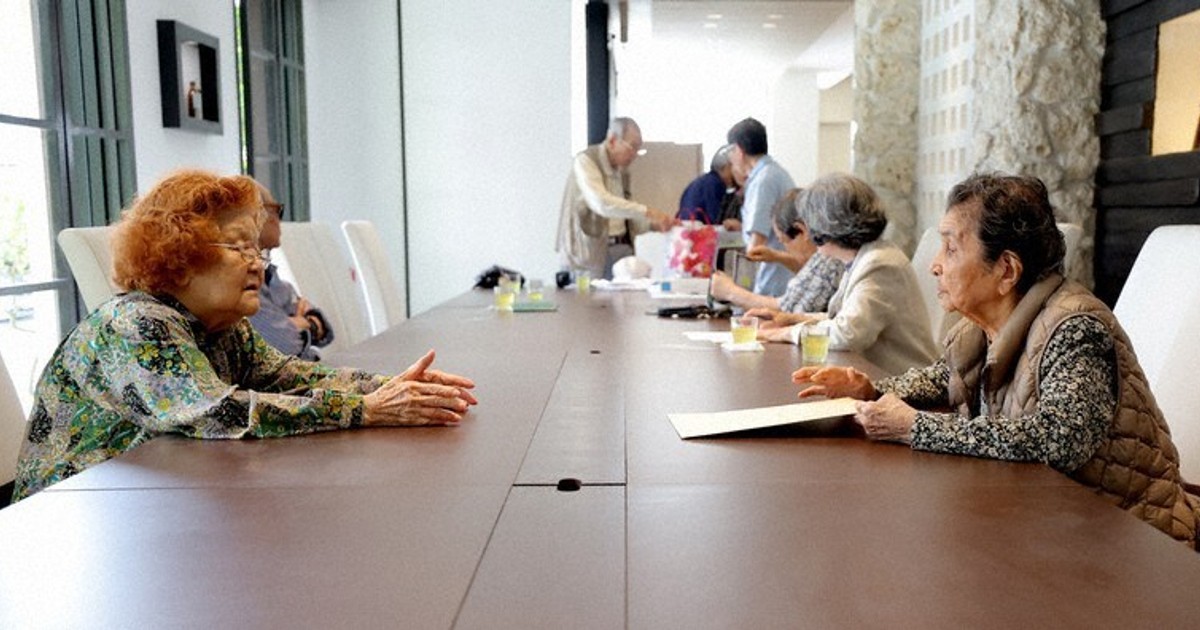
In early May this year, about 10 people gathered in Naha, Okinawa Prefecture, for a meeting of the Okinawa-Palau friendship association, made up of former migrants and others. Hiroko Maeda, 97, and Eiko Tamaki, 96, both of Naha, are alumnae of Palau Girls’ High School. They were delighted to see each other again after such a long time.

In 1922, Japan established the South Seas Agency in Koror, Palau’s main city. Palau, then the political and economic center of Japan’s South Seas Mandate. The island country was called a “South Seas paradise” for its clear blue waters and mild climate, and many people crossed the sea to settle there. People from Okinawa, in particular, were especially prominent among them.
Tamaki moved to Palau from the Philippines in the mid-1930s, early in the Showa era (1926-1989), when she was about 4 years old. Her family opened a tailoring shop in Koror. Her mother would wear clothes tailored at the shop and visit a nearby restaurant, often taking orders from women working there. The family made a living together and sent money back to their home in Okinawa, Tamaki recalled.
Maeda arrived in Palau with her family in 1940. “I wondered if there could be such a lively place,” she said. Koror’s urban district, lined with hospitals, schools, shops and other buildings, took her by surprise. It was unlike her hometown surrounded by mountains and the sea, where many people engaged in fishing.
As the number of Japanese migrants increased, elementary schools were established one after another across the islands. In 1941, Palau Girls’ High School opened in Koror. It was a four-year school said to have the same curriculum and class hours as girls’ high schools back in Japan.

About 60 members of the school’s first class are captured in a photograph, their hands on their knees and wearing short-sleeved blouses. Among them is Chiyo Nakaima, 99, now a resident of Tokyo’s Katsushika Ward. She lived in Palau comfortably with her parents, who operated a row house.
Palau Girls’ High School opened with fanfare, but toward the end of that year, the Japanese military attacked Pearl Harbor in Hawaii, ushering in the Pacific War. Maeda entered the school the following spring as part of its second class. She especially liked English. Even now, she can smoothly recite the English text of “The Giant Turnip,” a Russian folktale. There were also classes in Japanese dressmaking, swimming and naginata, a traditional Japanese polearm.
But the shadow of war grew darker by the day. Nakaima and Maeda were made to polish bullets at a Japanese military warehouse. Physical education classes also came to consist almost entirely of marching in formation.

Glimpses of the schoolgirls’ modest daily lives can be seen in “Tokonatsu,” the school association magazine of the time, which roughly translates to “everlasting summer.”
“After the squall / along the rows of palm trees / singing military songs / soldiers pass by
“Watching / carp streamers blown along / by the south wind / I miss my hometown”
Life at the lively girls’ school and nostalgia for their hometown were recorded in poems and other writings.
One morning in March 1944, Nakaima heard the roaring sound of aircraft. “Our forces have come,” she thought. Delighted, she went outside, only to see the sky filling with aircraft, which dropped bombs all at once.
They were U.S. forces. Koror’s urban district was turned into a sea of flame. Nakaima and her family took as much food as they could carry and crossed to a neighboring island in a small boat. Her classmates were scattered, not knowing whether the others were alive or dead.
Around the summer of 1944, after Nakaima and others had spent some time as evacuees, they received a notice. They were instructed to gather in Ngatpang on Babeldaob Island, north of Koror Island.
Their destination was the Japanese Army’s 123rd logistics hospital. The unit, originally formed in Aomori Prefecture in northern Japan, had 617 members. It was also called the Wakui Unit after the hospital director’s family name.
The area was in the middle of a jungle, with no private homes or shops around. The schoolgirls lived apart from their parents and worked as “nurses” at the field hospital while staying in lodgings nearby.
(Japanese original by Kanami Ikawa, Tokyo City News Department)
(This is Part 1 of a two-part series)
